// Twitter Cards // Prexisting Head The Biologist Is In: weeds
Showing posts with label weeds. Show all posts

Monday, September 10, 2018

Botanizing in Hawaii: Solanum linnaeanum

Closeup of flower, leaves, and stem of plant. Flower is pink with four fused petals, forming a square, and has yellow anhers gathered in the center. The leaves are heavily lobed, with long sharp spines protruding from the underside. The stem too is covered in dramatic spines.
Hawaii has a long history of biological invasions. Plants and animals from all over the world have arrived and thrived there under the tropical sun. This can make it somewhat difficult to identify a random plant, because it could literally come from almost anywhere on the planet.

On one of my hikes, I found several plants I immediately recognized a member of the family Solanacea. This is the same family that includes tomatoes, peppers, and eggplants. I was pretty sure it was even a member of the genus Solanum, one of the several species sometimes referred to as "spiny eggplants".

Closeup of a few leaves and two small round fruit. One fruit is entirely brown. The other fruit is pale green with darker green stripes. The leaves are heavily lobed and covered in spines.
 I collected a few fruit, intending to secure some seeds for planting back home in Minnesota. A couple days later, while sorting through my collection at a motel, I finally identified the plant as Solanum linnaeanum. Among its various common names are: "Poison Apple", "Devil's Apple", and "Apple of Sodom". They're native to parts of southern Africa, but have naturalized in Hawaii and various other places around the world.


The plant and its fruit are chock-full of toxins. Enough so that very few animals are willing to eat it. At about this point I decided not to take seeds home for garden trials. I do have a few seeds in my collection that come from highly toxic, or otherwise dangerous, plants. I wasn't entirely certain how much difficulty I would have with trying to leave Hawaii with collected seeds. If some official asked me what they were and why I had them, they might not appreciate my responses. So, to limit that risk, I dumped the S. linnaeanum seeds in the garbage.

(Several days later when I left the state, I learned I would have had no trouble at all. Dried seeds in vials didn't concern the USDA officials at the airport at all. Bringing seeds into Hawaii gets their attention, not taking seeds away from Hawaii. Next time I'll be a bit more bold.)


Interestingly, it appears this species can cross with domesticated eggplant (S. melongena). Doganlar et al. studied an F2 population derived from a cross of the two species in order to map the genomic positions of genes for traits important in domestication. Unfortunately, their paper doesn't have any photos of what the F2 plants looked like. Even with the risk of dragging the toxic traits from S. linnaeanum into the progeny, this would be a fun cross to recreate and explore. The wild species probably has numerous disease/insect resistance traits that would be useful in a garden eggplant, so there is probably value to the experiment beyond simple personal amusement. There's a few online vendors offering seed for this species, so I won't have to make another trip to Hawai'i to start on this project.


References:

Tuesday, January 17, 2017

A Pretty Little Weed

One of my favorite roadside wild-flowers is the invasive Eurasian weed Lotus corniculatus (Bird's Foot Trefoil).  It is almost always found in a bright yellow, but I've been keeping a look out for forms with other colors. I occasionally find plants with enhanced red/orange streaking, but never as intense as the one in the photo below. I did once find plants with distinctly [pale-]orange flowers in a southern California ocean-side park. (Unfortunately there were no seed pods to be found.)

I found the following representative images from various sources online.

Cluster of small yellow flowers.
L. corniculatus in yellow.
Cluster of small orange flowers.
L. corniculatus in orange.
Cluster of small yellow flowers with red marks.
L. corniculatus with red streaks.

I'm really quite surprised I haven't found any evidence for a white flowered variation. All it would take is a single mutation to inactivate one of many genes involved in the early steps of the pigment pathway, which should make it a pretty easy variation to arise. Maybe white flowers don't attract whatever pollinates this species and so the trait would rapidly die out after being formed.

The plant family containing this species (Fabaceae) has flowers covering the whole spectrum of flower colors. Reds, blues, yellows, and whites are all common. These colorful relatives suggests there may be the genetic potential for more color diversity within this species, even though they are not yet apparent.


Additional interesting flower color genes can be found in close relatives. If we're very lucky, maybe these related species could cross to L. corniculatus. Improving the floral characteristics of a common weed isn't the sort of project that is going to get much research funding, so there might not be much information available about the possibility of inter-species crosses within the genus. For now, lets just make pretend that we can do these crosses and have a look at what genetics might be available in the genus Lotus.

Cluster of small yellow and white flowers, next to cluster of narrow elongated seed pods.
L. pinnatus
The closely related L. pinnatus (Bog Bird's Foot Trefoil) is an uncommon species found in western Canada and the USA. Its lower two petals are splayed open and a bright white color. These flower traits suggest this species would be interesting to cross to the more common weedy species. L. pinnatus grows as a sprawling plant in boggy wetlands.

This dramatically different lifestyle of this species means there would be many non-floral traits that would need to be cleaned up via back-crossing to L. corniculatus if we wanted to maintain the growth form of the original weed. I like the weed's growth habit, so this would be a goal for me.

Cluster of small yellow and purple flowers.
L. formosissimus
A similar species to L. pinnatus is L. formosissimus (Seaside Bird's Foot Trefoil). This one has the same fancy flower shape, but comes in a greater diversity of color forms.

Four small dark red flowers.
L. tetragonolobus
Another close relative is L. tetragonolobus (Asparagus Pea). This species produces edible (and tasty) winged seed pods. The flowers are a brilliant scarlet-red, which would be a lovely trait to bring into the mix. The plant grows as a low mound, much like L. corniculatus, so I wouldn't need to worry about cleaning up the genetics of a cross so much. They also seem to come in versions with yellow flowers. The traits that result in this species having tasty pods might also be a cool thing to select for in any hybridization projects. (Maybe I'll just grow this species in the garden anyhow.)


Some more research into this group reveals there is abundant information about hybridization between species. The reason is that the various species are common forage plants in pasture. Any species impacting agriculture will have a lot of research done on it.

Some of the hybrids I can find information for:
  • L. corniculatus x L. tenuis
  • L. uliginosus x L. tenuis
  • L. corniculatus x L. stepposus
Unfortunately, none of these species have much of anything going on for interesting flower colors. That these crosses work, however, suggests other crosses in the genus might also work. Knowing something about how many chromosomes are found in species of the genus might help sort out what crosses have a better chance of working, but it really comes down to simply trying the crosses and seeing what happens.


References:

Sunday, January 8, 2017

Black Nightshade 2

The potential toxicity of Solanum nigrum fruit has been much debated. I had previously written about this species and some thoughts about why people might think it was poisonous. I generally consider it's ripe fruit to be edible and I routinely eat small numbers of them with no negative effects. However, there are still reliable reports of toxic reactions to the fruit (Joseph Lofthouse's reporting) that should be cause for concern to those unfamiliar with the plant.

I think the species had great potential as a future domesticated plant for the vegetable garden. The plants don't seem to have any real disease issues, especially when compared to the related tomatoes. Improvements in fruit size, sweetness, or total production would be worthwhile traits to develop. To that end, I've been on the lookout for wild plants with improved traits to help start a breeding program.

Last summer (2016) I grew several plants from saved seed. In our fenced in garden area, several additional wild weedy plants grew. I was pleased to find one of the wild plants had large berries, on average maybe twice the volume of the berries I'd planted. Rabbits were getting into the garden, so I kept a close watch on the plant while waiting for the fruit to mature.

Small round black berries at bottom, larger round black berries at top.
Top: Extra-large and extra-toxic.
Bottom: Typical and edible.
Once most of the berries had ripened, I collected a sample from the different plants. I took the berries inside to photograph and save seeds. The smaller berries tasted just as I had expected. The larger berries...  I immediately spit them out. The larger fruit had a significantly higher level of solanine than I had ever experienced in this species. I knew exactly what this agent tasted like from tasting the closely related S. dulcamara, which is consistently toxic to humans.

This plant exemplifies some of issues leading to the ongoing debate about this species. I'll eat berries from most plants of this species, but there is no way I would ever eat a handful of berries (or even a single berry) from this plant. I know how to recognize the plant's poison, but you may not.

It took me several years of sampling fruit from every plant I found of this species before I found one that was poisonous. You might find a poisonous one on your first try. Your risk of tasting a couple berries will be minimal, but you should always take great care when eating a plant that you're not very familiar with.


Even though the larger berries were toxic, I'm still going to plant the seeds I collected from them. I'm hoping some of the plants in the next generation will have the larger fruit and yet not be toxic. Even if the two traits are closely linked, eventually I should be able to find a plant that separates them. Wish me luck.


References:

Tuesday, July 19, 2016

More Crop Mimics

I've previously posted about a form of mimicry in plants (called Vavilovian mimicry) where one [or several] wild species end up mimicking a crop species due to the selection pressures in crop fields. Since then, I've come across a few other species that are useful examples for the topic.


At top, a row of wheat seed heads. At bottom, a row of similar seed heads to a plant called darnel.
Wheat (top) vs. Darnel (bottom).
[from link]
Darnel (Lolium temulentum) is a  mimic of wheat. It looks almost identical to wheat plants right up until the seed heads form (see at right). The seeds themselves are large and are indistinguishable from those of wheat after threshing. The seeds are also highly poisonous, leading to the common name of "Poison Darnel". When wheat contaminated with sufficient Darnel is milled into flour, the resulting bitter taste reduces its value.

Darnel control efforts have limited success and the plant is found essentially everywhere wheat is grown. Even though the toxic character of this species (when infected) means it will likely never be developed into a primary crop, it is still a nice example of Vavilovian mimicry.


Another common weed in wheat fields is Small Canary Grass (Phalaris minor). It also produces large seeds that would probably get sorted with wheat seeds at the end of the season and its seedlings look very much like those of wheat.

As a general rule, any random grass species is going to be a much better mimic of the grass we call wheat than any other random type of weed would be. Of the five weed mimics of wheat that I've come across (below), all are grasses and three have become major crops in their own right.


Rice crops are often plagued by weedy forms called "Red Rice" due to the red color of their seeds. They are generally less productive than the main cultivated varieties, so farmers try to keep it out of their paddies. Red-Rice happens to be the same species as the cultivated types. It evolved from (or alongside) cultivated rice so it really isn't a case of Vavilovian mimicry, even though it is a useful example in the discussion of crop weed mimics.


References

Tuesday, March 1, 2016

Vavilovian Mimicry

Vavilovian mimicry is a form of mimicry where an agricultural weed begins to take on characteristics of a domesticated agricultural crop due to the selective forces present in the agricultural system.

The first example is involving wheat. Well, really, it involves both wheat and barley. During the early phases of domestication of these grains, they weren't distinguished as separate plants. Initially, the large seeded grasses were collected from the wild and planted closer to home. The now-farmers would then collect the large seeds from the grasses they grew, eat most and protect some, and then plant what was left the following year. You could say that wheat and barley are Vavilovian mimics of each other, because we really don't know which was the first grass to enter domestication.

At some point while the wheat/barley agricultural system was developing, other weedy grasses invaded the prime growing habitat found in the fields. Two of these weeds evolved to become what we call "rye" and "oats". They developed larger, non-shattering seed heads and an annual life-cycle. This allowed their seeds to be collected, saved, and planted as contaminants to the main crop. Both rye and oats are more tolerant of cold conditions and poor soils. Because they had become mimics (and contaminants) of the major crop, when farmers tried to establish the crop system in marginal conditions, these mimics can come to predominate as the major crop.
Wheat/Barley -> Wheat (Triticum spp.)
Wheat/Barley -> Barley (Hordeum vulgare)
Wheat/Barley -> Rye (Secale cereale)
Wheat/Barley -> Oats (Avena sterilis)


Another often-cited case of Vavilovian mimicry is found in the agriculture of lentils (Lens culinaris). A common weed in lentil fields is the Common Vetch (Vicia sativa). The Common Vetch seeds are bitter, so farmers are able to sell their crop for less if there is too much vetch contamination. As farmers have increased the selection pressure on the vetch by mechanical (and computer-vision) assisted seed sorting, strains of the vetch have evolved so that their seeds mimic the lentils in color and size, as well as the characteristic flattened lens-shape.

A. Lens culinaris. B. Vicia sativa, wild and mimic.
(from: www4.ncsu.edu/~fgould/pdfs/Gould1991.pdf)
Lentil (Lens culinaris) -> Common-Vetch (Vicia sativa)
Lentil (Lens culinaris) -> Black-Pod-Vetch (Vicia sativa subsp. nigra)
If farmers could impart some selective force on the mimic vetches such that they would lose their bitter flavor, they would have effectively created a new crop. This new crop might grow better in some conditions where lentils don't thrive, thus spreading the useful area of agriculture.


The selection force involved in the development of Vavilovian mimicry can be mechanical (as in Flax weeds) or manual (as in Rice weeds). What is key is that the selection force separating weeds from the crop has to progressively get more and more stringent over time. This allows the weed population to always have some individuals that will escape the selection force applied to them.
Flax -> False-Flax (Camelina sativa linicola)
Flax -> Flax-Dodder (Cuscuta epilinum)
Rice (Oryza sativa) -> Early-Baryard-Grass (Echinochloa oryzoides)


An interesting case that I think is related to Vavilovian mimicry is the complex of Andean tuber crops. I don't know which crop was first domesticated in this region, but since before modern history, five species of tuberous crops have been traditionally grown together in fields. Growing several different crops together in this agricultural system mean that there will always be production, even if any given plant doesn't produce in some year (due to weather, disease, or other factors).
Potato (Solanum tuberosum) -> Maca (Lepidium meyenii)
Potato (Solanum tuberosum) -> Oca (Oxalis tuberosa)
Potato (Solanum tuberosum) -> Mashua (Tropanolum tuberosum)
Potato (Solanum tuberosum) -> Ullucus (Ullucus tuberosus)
Though I doubt any of these species entered the agricultural system as weeds, I expect that each species will undoubtedly have evolved towards a set of traits similar to those of the most common plant grown in the fields. Any individual plants that didn't prosper in the agricultural system would have contributed less to the next generation and the species would shift to a form that did prosper. This shifting of the traits of one species to align with another, due to the selection forces favoring the majority plant species, is a characteristic common between Vavilovian mimicry and whatever this case should be referred to as.


References:

Tuesday, December 8, 2015

More Convergence on the Seaside

Cakile maritima on a southern California beach.
(I know this one is tasty, in real life.)
In a previous post (the-biologist-is-in.blogspot.com/2015/03/convergence-on-seaside.html), I discussed two seaside plant species that both have succulent, edible (and reportedly tasty) leaves.
Cakile maritima (Sea Rocket). [Brassicaceae, annual]
Crambe maritima (Sea Kale). [Brassicaceae, perennial]
Since then I've found a selection of other seaside plant species that all have succulent, edible leaves.
Blutaparon vermiculare (Silverhead, Saltweed). [Amaranthaceae, perennial]
Cakile edentula (Sea Rocket). [Brassicaceae, annual]
Cakile lanceolata (Sea Rocket). [Brassicaceae, annual]
Crithmum maritimum (Sea Fennel, Rock Samphire). [Apiaceae, perennial]
Eryngium maritimum (Sea Holly). [Apiaceae, perennial]
Limbarda/Inula crithmoides (Golden Samphire). [Compositae, perennial]
Salicornia bigelovii (Marsh Samphire, Dwarf Glasswort). [Amaranthaceae, perennial]
Salicornia europaea (Marsh Samphire, Glasswort). [Amaranthaceae, perennial]
Salicornia virginica (American Glasswort, Pickleweed). [Amaranthaceae, perennial]
Salsola soda (Barba di Frate, Agretti, Liscari Sativa). [Amaranthaceae, annual]
Sarcocornia quinqueflora (Beaded Samphire, Beaded Glasswort). [Amaranthaceae, perennial]
Sesuvium maritimum (Annual Sea Purslane). [Aizoaceae, annual]
Sesuvium portulacastrum (Sea Purslane). [Aizoaceae, perennial]
Tecticornia arbuscula (Shrubby Glasswort). [Amaranthaceae, perennial]
Tecticornia pergranulata (Blackseed Glasswort, Blackseed Samphire). [Amaranthaceae, perennial]
What is it about the seaside environment which is selecting plants to be succulent and edible? I've got some thoughts that I think lead to a partial answer. Let's break down the question into two parts.

Why are they succulent? The seaside substrates where these plants grow is typically composed of sand, gravel, or rock. These substrates don't hold water at all. Even though there is an ocean very nearby, any small plant growing above the high-tide line is effectively growing in the middle of a desert. Two main strategies for this situation are 1) grow extremely deep roots and 2) hold onto any water that they find. The first strategy is typified by Creosote (Larrea tridentata) and Mesquite (Prosopis spp.), neither of which would be described as edible. The second strategy of holding onto their water, means a plant will be succulent in some way or other. There are plenty of both toxic and edible succulent plants, so there is more to the story.

Why are they edible? Some of the plants are perennial, while others are annual. Before I started looking into it, I was thinking they were all weedy species. Weedy plants (or animals) are those that invest a lot of their energy in reproduction, while investing very little in self-defence of any specific individual (r-selected). For plants, this means they're typically annuals (or short-lived perennials) that don't invest much biological energy into growing spines, fibers, or poisons. In short, r-selected plants are more likely to be edible to generalist herbivores like ourselves. Now, that none of these species would count as a long-lived perennial (like a woody shrub or tree) may perhaps mean that the weediness argument has some value in understanding this group of plants.

Before I started looking up these species, I had never heard the name "Samphire" before. The name seems to be used generally for any succulent (and edible) weed growing on a rocky seaside of the northern British Isles. Several of them are described as being easy to grow in a garden setting. Some of the plants can grow directly in sea-water. These may be a bit trickier to grow in the home garden. I like growing interesting plants, so hopefully I'll be able to try growing some of them over the next several years.


References:

Tuesday, October 13, 2015

The Gall of Those Goldenrods

S. canadensis flowers.
Goldenrods (genus Solidago) are blooming prolifically in southern Minnesota. This patch is near the building I work at, but I find them blooming in parks, along roads, and in my own yard. Though they are considered weedy and potentially invasive, I like the look of the flowers and they make an interesting subject for study due to the various animal species which interact with it.

One of the more studied interactions is between the Goldenrod and the Goldenrod Gall Fly (Eurosta solidaginis). This fly causes the Goldenrod to grow hard bulbous galls in the main stem that are referred to as "ball galls". The galls are easy to collect during winter, so ample material is available for teaching or research purposes.
S. canadensis flower galls.

Though I have found a few of the ball galls, the Goldenrod patch near my work didn't seem to have any. The patch was full of another type of gall, however. These galls are formed at the top of the stem and look like a tight cluster of leaves, forming a flower-like head structure. Because of the appearance, they are referred to as "bunch galls", "rosette galls", or "flower galls".

Goldenrod flower gall.
If you take one of these flower galls and dissect it carefully, it has an internal structure very similar in organization to the flower of a sunflower plant. There is a broad flat disk with leafy structures (florets or leaves), on top of a pithy core which widens as it approaches the base. Ok, I admit it is a bit of a stretch, but there is enough similarity to have the name "flower gall" make some sense.

When I first saw these galls, I had assumed they were caused by an infection with a fungus that was using the flower-like structure to trick insects into carrying its spores to other plants. (Check out the Cedar Apple Rust gall for an example of a fungal "flower" used for spore dispersal.)

R. solidaginis larva.
When I cut open the Goldenrod flower gall, I found several small insect larvae. They had no identifying markers, aside from their characteristic flower gall. After doing a bit of research, I found these were larva of the Goldenrod Gall Midge (Rhopalomyia solidaginis). These small flies are parasites of a specific Goldenrod species, Solidago canadensis.

I've had limited success finding information about the life-cycle of the Goldenrod Gall Midge. The few references I've found which talk about the insects' life cycle refers to two life-cycles per year. The larva I found represent the summer juveniles, which will pupate into fall adults. These fall adults will lay eggs in the ground (or the base of the Goldenrod plants?), which then quickly hatch and overwinter as larvae. These larvae would then grow quickly and pupate in spring to make the later generation of adults to infect the Goldenrods and produce the flower galls. I've known that the life-cycles of parasites often include multiple hosts or stages of growth, but I didn't realize this one was going through its complicated life right under my nose in the wild-flower patch.


References:

Tuesday, August 18, 2015

Wild Carrot Flowers

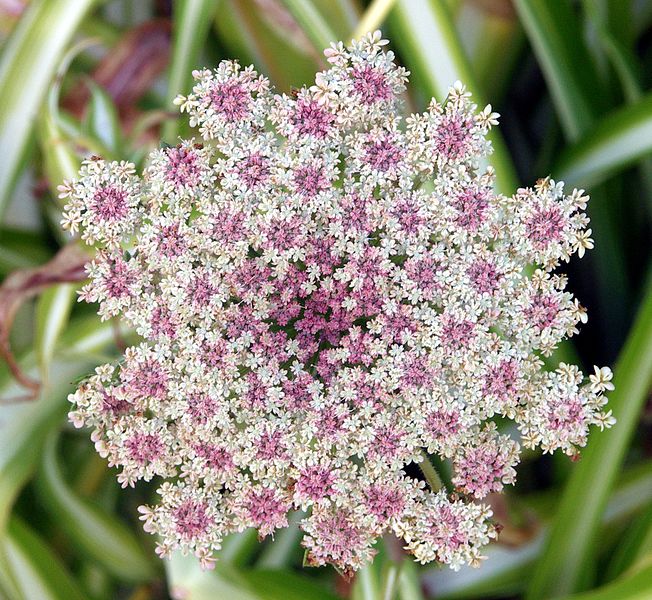
Wild Carrot (Queen Anne's Lace, Daucus carota) is a common roadside weed/wildflower. The typical flower structure is a flat umbel with hundreds of tiny flowers. The florets at the edge have larger petals on their outer sides. Some of the plants produce a small number of dark purple florets (usually just one) in the center of the umbel, but it isn't clear why it does so. The purple florets are considered sterile (though this photo suggests not always), so there has to be some selective advantage to having them that maintains their presence in the population. Some suggest the dark floret acts as an insect mimic to draw in flying pollinators, but the research is ambiguous at best.

While was taking photographs of one plant, an ant climbing across the surface of one umbel paused to investigate the dark center floret. This started me wondering if the plant might have improved pollination from ants crawling across it with the dark purple center to attract them. More generally, the dark floret could act as a nectar-guide to draw bees and other effective pollinators to the umbel. The impact on insect visitation (and presumably on fertilization) of dark marks has been shown for other plants, so it is reasonable to extrapolate the same adaptive role may be at play in the wild carrot.

Once the dark central floret drew my attention, I looked for variations in the trait within the small population I was walking along. The most pronounced difference I noted was in the height and size of the central floret. In most plants the central floret was held at the same level of all the others. In some few it was held below and in one, a larger central floret was held well above the other florets in the umbel. I thought this was an attractive variation, so I harvested a near-mature seed-head from the plant. I might grow a plant or two in a controlled location some time -- when I'm not trying to get seed from edible carrots (they readily hybridize), that is.

I also noted some variation in color of the central floret. The typical example is a very dark purple, but I also found a few plants with a much lighter pink central floret. I don't really like the aesthetics of the photo at right, but it was the best I got when trying to place the two different colored central florets next to each other for comparison.

The diversity of variations of the central floret in this small population suggest that the trait isn't under strong selection (at least in this small population). If a trait is under strong positive selection, mutations which interfere with it will rapidly be lost. To me, this suggests the dark central floret is a historical anachronism. It was once under strong positive selection, which is why it is so common, but it is not now under such selection (again, at least in the small population I examined). This could mean that in whatever small corner of the world where the plant came from, there is a specialized pollinating insect that likes the dark central floret. When the plant started traveling with humans, it found other pollinators that didn't care if it had the central floret and the trait began to diverge as mutations accumulated. If this hypothesis has any sort of validity, then we would predict that where carrots originally evolved (Afghanistan, Turkey) there would be less variation in this central floret trait.


Once I started looking online for carrot flower color variations, I found a few photos people have taken of wild flowers in shades of pink and purple (in references below). I found a nifty blog post discussing how to dye Queen Anne's Lace using food-coloring. I even found a variety of Queen Anne's Lace being sold commercially that has darkly-colored flowers.


References:

Monday, March 9, 2015

Convergence on the Seaside

Cakile maritima flowers.
I found this plant growing on the beach on a trip to southern California two years ago. The four-petaled flower and shape of the seed pods told me it was in the family Brassicacea, like the wild radishes which are common in the region. The thick and succulent leaves, however, indicated this plant was unlike any plant in the family I had seen before. I collected a few seed pods, hoping to later identify the plant.

After periodic internet searches over the last two years, whenever I found myself thinking about the plant, I finally found an image of a flower with the right shape and color that also grows in beach habitats above the high-water line. I've identified the plant as Cakile maritima (European Sea-Rocket). It and the related C. edentula (American Sea-Rocket) and C. lanceolata (Coastal Sea-Rocket) have small seed pods which contain one or two seeds and are dispersed by floating in water. The pods and leaves differ in shape between the species, but they are otherwise very similar.
C. maritima seed pods.

The species in this genus are generally described as edible, with leaves tasting spicy like horseradish. The plant I found had leaves which tasted mostly sweet. This may be just because I chose young leaves to taste, or I might have lucked onto a plant that was mild instead of hot. Hopefully the seeds I've stored will germinate so I can find out. Either way, I see it as an interesting plant to develop for the salad garden.

Sea-Rocket is commonly described as edible, but it doesn't seem it was ever a major crop. I've found one reference to it being grown in a garden in 1596-1599, but it isn't clear if was grown for vegetable or botanical use.

Another interesting beach-side plant in the Brassicaceae is Crambe maritima (Sea-Kale). Both plants have succulent leaves and dry fruit that effectively float and disperse their seeds. I find interesting that the two species evolved convergently from related ancestors to similar forms in the shared environment of European coastlines.

Sea-Kale appears to have been commercially harvested in Roman times and was cultivated in Europe from around the 1600s, but went out of fashion around the time of WWII.

References:

Thursday, January 8, 2015

Weedy plant domestication

Most of our garden vegetables and crop plants started out as weedy plants.   Part of the evolutionary syndrome of being a 'weedy' species is being r-selected ("r" for reproduction), meaning the species invests in producing as many offspring as possible instead of defending any one life that much. The opposite reproductive strategy is referred to as K-selected ("K" for… well, I have no idea), meaning a species invests a great deal in each offspring to help ensure they have a high chance of survival.

In the context of plants, this means that weedy plants tend to not be spiny, tough, or poisonous... In short, weedy plants tend to be more edible for a non-specialist vegetarian like us humans.

Since I was a child, I've liked the idea of domesticating weedy plants. I have several projects in mind, but have only taken the earliest steps of gathering seeds for some plants I find interesting (Arctium lappa, Carduus nutans, Lepdium virginicum, Leucanthemum vulgar, Malvaviscus drummondii, Oenothera biennis, Thlaspi arvense).

The internet is a wonderful thing in that it lets one find others who have similar interests, no matter how esoteric.

The left half of the image is a botanical plate for Plantago major. It is a common yard side weed native to Europe and Asia. It is easily confused with the related native species Plantago rugelii, which is equally weedy and much more common.

The right half of the image is the result of a project by a plant breeder over at Arrowhead Alpines.   The variety is named "Purple Perversion".   If you order the plant, it will probably spread its genes widely - contaminating the Plantago population already growing in your yard with genetics for interesting colors and textures. (Some other varieties can be found at Plant World Seeds.)

Plantago species have edible leaves that are rich in B vitamins, which gives them a savory taste reminiscent of mushrooms. Some further selection, perhaps with mutation breeding, could transition this plant from a yard weed to a prime garden vegetable. As a domestication project, this plant is already partly done, so I could imagine making significant progress with it.

References:

Saturday, December 27, 2014

Mystery Plant ID Found!

1. omnilexica.com/?q=silphium
A little over a year ago, I was involved in a wedding party and we were walking through a park to a site for some of the arranged photographs. Along the walk, we crossed a stream and there I came across an interesting plant.

The plant was done flowering, but the seed heads retained a nice green color and had the lovely geometry seen in image #1. I picked a sample of the plant, using the pocket-knife I almost always carry (largely for such purposes as this).

Neither myself, my mother, nor my aunt were able to identify the plant. Now this was getting interesting, as my mother and aunt have a long history of gardening and interest in wildflowers. My aunt noted the material had the scent of sunflowers, but this only helped identify it to the family level, which the structure itself had already provided. I tucked the sample into my pocket, hoping to keep it intact until I could identify it at some later time. On returning home, I consulted the field guides I owned. I had no luck, since they all seem to focus on the most charismatic aspect of the wildflowers…  usually, the flowers themselves.

As the plant material dried, I realized that I had collected very mature looking seeds of this unknown plant. I cleaned the seeds and stored them in a vial, hoping to identify them when I later had the chance to grow plants from them. Part of the motivation was also because I thought that the green seed heads would make a nice display in a vase, so I could use the plant as part of my home flower cutting garden.
2. diggingdog.com/pages2/plantpages.php/P-1403

…a year passes…

I am in the final stages of completing my PhD thesis and found my mind wandering. I was reading about the efforts to breed perennial versions of annual crops and to domesticate new perennial crops from wild plants. While looking through a document on the efforts to generate perennial seed crops, I saw a dried plant specimen of Silphium integrifolium (Deam's Rosinweed) and it struck a memory. A quick web-search later and I found an image of exactly what I discovered on the creekside. However, there are several potential species in the genus Silphium that live in the area and have the memorable seed heads, so it will still take growing the seeds I saved to identify the plant down to the species level.

The plant was being studied for its domestication potential as a new seed crop. I still think it would be a worthwhile project to domesticate it as green material for florist use. Domestication of a single plant species can easily go in multiple directions at once, as the plethora of cabbage/broccoli/etc. plants indicate.

Now that I know what the plant looks like and that it will produce some really nice flowers (image #2), I can better plan for where the plant will go in my garden next year.

References:

Tuesday, March 4, 2014

Domesticating Garlic Mustard

Garlic Mustard (Aliara petiolate) is considered a noxious invasive weed throughout North America. Very few animals find the garlicky taste palatable (deer will preferentially browse on native plants), so it spreads unchecked and can take over in areas where it gets a foothold. It was brought to this continent by European immigrants, who planted it in their gardens for use as a potherb (imagine boiled spinach).

The plant is entirely edible, from root to flower. Analysis has shown it to be high in vitamin C, fiber, and other nutrients. Garlic Mustard does contain cyanogenic compounds and so should be cooked to break down these compounds if it is consumed routinely. This trait puts it in the good company of lima beans, cassava, and flaxseed.

As long as you don't routinely eat it raw in large quantities, you shouldn't have a problem with the cyanide levels you would be exposed to. Remember, the dose makes the poison.


The Lettuce (Lactuca scariola/serriola) and Endive (Cichorium intybus) we enjoy as delectable salad greens were once spiny, bitter weeds. These plants have been shaped by our desires and have hitched their evolutionary destiny to our own.  This process is referred to as 'domestication' and can happen with or without the conscious action of the people growing the plants.

The idea of domesticating random plants amuses me. Garlic Mustard already makes a decent vegetable and I suspect that with some work, it could be made into an excellent vegetable.

A key requirement for breeding a new variety of a plant is having some genetic diversity to work with. To get this starting diversity in Garlic Mustard, I could wait a few hundred years in cryostasis while my henchmen scour the planet looking for some interesting variations of the plant… or I could induce a bunch of mutations and be done with this step in a few years.

I've decided to go with the quick option.
'Kinnow' -> 'KinnowLS'

Agricultural research labs routinely use various chemicals, particle radiation, or x-rays to induce mutations in plants. They then screen the mutated results for improvements in some characteristic to make the plant more useful/tasty/nutritious/etc. The process is known generally as 'mutation breeding' and has been widely used since the 1970s. The seedless orange in the figure at right was generated by mutating the seeded orange, then screening through the mutated progeny for the desired improvements.

I don't feel like dealing with aggressively mutagenic chemicals and I don't have ready access to a particle accelerator or an X-ray generating machine, but I do have ready access to another form of mutagenic radiation. Ultraviolet (UV) light is the component of sunlight which is responsible for giving us a sun-burn. The thymine bases in our DNA absorbs the UV light and becomes chemically altered.   The alterations can result in base mismatches or strand breaks as the excess energy from the UV dissipates. Shortwave UV, or UV-C, is particularly good at damaging DNA and can be produced by commercially available bactericidal-UV fluorescent light bulbs.

Garlic Mustard seeds are small enough that sufficient UV-C light should get to the embryo and cause the mutations I'm looking for. There's no risk to me, as long as I don't get exposed to the UV-C bulbs, so it is a major plus over X-rays or mutagenic chemicals.


After acquiring some UV-C lamps and setting up a light-tight enclosure (so I don't sunburn my eyes/etc.), I will have to determine the radiation dosage needed to successfully mutate the seeds. A reasonable method is to irradiate batches of seeds for different times, then compare their germination to an un-irradiated control. The dosage corresponding to a 50% reduction in germination will give me the most bang for my buck…  producing lots of mutations, but still giving me lots of viable seeds to work with.

Damaged DNA by itself is not a mutation. The damaged DNA has to be repaired with some new change to count. A method to encourage the repair of the damaged DNA is to wake up the seeds by soaking them in water a few days before mutating them, allowing them to restart their paused metabolism. This should result in a higher survival rate with more actual mutations, rather than dead seeds with shredded DNA.

Any dominant-effect mutations will be apparent the first generation after mutation (M1), but many mutations are likely to be recessive and will only become apparent in later generations (M2, etc.).


The first thing to consider relates to the current problems caused by the plant. It is highly invasive, spreading seeds everywhere and taking over wild-lands. An ideal garden vegetable would be a bit more polite and stay where we want it. How would we select for a more polite weed?

A primary difference between wild and domesticated plants is that wild plants drop their seed (referred to as 'shattering') and domesticated plants retain them until we intervene. This single trait would go a long way to convert the noxious, invasive weed into a polite garden inhabitant.

Fortunately, all I need to do to get this trait is to break the existing system the plant uses to drop its seeds. Since I'm going with a mutagenic approach, which essentially is breaking things randomly, I can expect to break this system in some plants. They key detail is to actively screen the M1 and M2 plants for modifications to the shattering trait and then to only work with their descendants. This will keep my potentially interesting garden plants from spreading and taking over wild lands like the wild Garlic Mustard plant.


At this stage of the project, I will have to develop some idea of what my breeding goals are.

Food quality related traits are likely to be easy to examine and select for. Larger roots/leaves/flowers? More delicate, sweeter leaves? Making the plant better for something that people already use it for will produce it something that someone will want to use.   People already use Garlic Mustard for a wide range of recipes, so there are many potential directions.