// Twitter Cards // Prexisting Head The Biologist Is In: breeding
Showing posts with label breeding. Show all posts

Friday, March 3, 2023

Chile breeding

Plant breeding involves a great deal of luck and you can have some really good success with that. Luther Burbank produced numerous amazing plant varieties, but at the same time, he never believed in genetics. The key aspects of his method were to just try things, to grow large numbers at every stage, and to pay close attention to every plant (to find the differences). He tried crossing a strawberry and a raspberry... and actually got something.

With some knowledge, you can make predictions about what is more likely to work. To that end, plant breeders have researched what techniques are needed to hybridize different species. Usually there is limited success with hybridizing species in different genera, where the plants are less closely related, but there are exceptions. In the end, species labels are things we make for our convenience. Nature is under no obligation to follow what we think a species is or should be.


In peppers there are several domesticated or partially domesticated species:
  • Capsicum annum : common sweet & hot peppers in North America.
  • C. baccatum : more common in South America.
  • C. chinense : habanero type peppers.
  • C. frutescens : generally smaller, less common peppers. 
  • C. pubescens : rocoto, manzano, locoto; tropical peppers with black seeds.
There are many more wild species that are only occasionally or rarely grown by gardeners. Those species contain a wealth of potentially useful genes though. Disease resistances, agronomic traits, and novel flavors can all potentially be moved from the crop wild-relatives into domesticated peppers. Towards that end, researchers have tried crossing almost any pair of species related to domesticated peppers. The following figure shows a crossability polygon, summarizing the results from attempts to hybridize between eleven species in the pepper genus.

I found the figure several years ago at: www.plantsciences.ucdavis.edu/vc221/pepper/PEPPERrd.htm. I have not yet been able to find the paper in which this figure was first published.

There are other wild pepper species, which could maybe be included in a more recent version of the figure.
  • C. lanceolatum: a cloud-forest species sharing the trait of black seeds with C. pubescens.
    C. rhomboideum: a species barely considered to belong to the genus Capsicum, with yellow flowers, sweet berries, and brown seeds.
  • C. annum var glabriusculum : tiny, very hot, wild pepper of the desert southwest US.
  • And many others...


What this diagram suggests is that you could transfer an interesting trait from any one of these species into any other species you're interested in working with, either directly or through intermediaries. It would just take motivation, time, and money to do so. More generally, hybrids between the species would let one introduce much more genetic diversity into their pepper breeding projects, even if there wasn't a specific trait of interest.

I'm working with lines that include C. annum var glabriusculum in their recent ancestry. This was the wild pepper which grew in San Antonio and Austin Texas where I grew up. I started by growing seeds for the species which I (or friends and family) had collected from the wild. At one point, a few seeds collected from a large, seemingly wild plant grew up showing the parent plant had been a hybrid with some unknown domesticated type. I've been growing the descendants of those plants since.

Left half shows several miniature pepper plants growing in two rows. Right half shows numerous tiny black and red pepper pods drying.
At left is an side view of a patch of miniature pepper plants grown in 2022. Here they're about 4.5 inches tall and the tallest matured to about 8 inches in height. The smallest stayed under an inch (and didn't mature any pods). This line has the small leaves and pods of its wild ancestor, but has a far more dense branching structure and short stems. They produced more and more dark purple/black pigment in the leaves as the season went on. The pods matured from black to bright red at final maturity. The pods range from very hot to volcanic. The plants were covered in black and red pods at the end of the season.

Other plants derived from that initial wild hybrid had larger, more typical forms, though they were still small in size compared to many garden types. Among those, one plant (at right) stood out as extra productive in 2021. I had been hoping to select up a productive hot pepper type since the more standard types have been not doing so well with my short growing season. I grew 25 plants in 2022 from seeds saved from this plant.

Those plants made it clear the productive parent plant had been a new hybrid, between the wild hybrid derived plants I was growing and the Pimenta da Neyde pepper I had been growing the year before. In addition to a wild range of leaf color and plant growth habit in these F2 plants, I also found several with decently large pods at various heat levels.

At left a single habanero type pepper cut open to show orange capsaicin oil rich internal membranes; at right four small jalapeno type peppers with longitudinal corked surface cracks. Both peppers are bright red.
The split pod at left came from a single plant which seemed to mimic a habanero. The pods had very thin walls and had a heat comparable or higher than habaneros. The internal membranes look so enriched in capsaicin oils that I was hesitant to try tasting them. Other plants seemed to mimic jalapenos, with their thick flesh and corked skin. These peppers are smaller than real jalapenos with a moderate heat level. The plants with both types of pods were far more productive than any habanero or jalapeno I had grown in my gardens, so I took this as a win.

Though I can't be sure, I have a pretty good feeling that all of these peppers are able to grow as well as they do for me in part because of some genes inherited from their recent wild ancestor. They handle the poor soil and limited water in my garden far better than usual garden types. The miniature peppers absolutely have their size and growth habit in part due to their wild ancestry.

In the next several years I hope to stabilize several new varieties from this project. Even if I don't, I'll be getting plenty of hot peppers along the way.


References:

Friday, December 30, 2022

The Color of Beans 2

A few years back I wrote a short post to introduced a project I had started to breed up a nicely blue colored dry bean. 

https://the-biologist-is-in.blogspot.com/2018/10/the-color-of-beans-1.html

The project as been moving forward nicely since then. This year's crop was very consistently blue in color, the first time I didn't harvest a large fraction of tan/blue seeds as well.

Dry beans in mixed colors. Browns, blues, and dark greys.
The picture at left looks very similar to the one I included in the post linked above, but this photo is from a few days ago. These beans are the extras I had saved from earlier generations, including many from 2018. This tells me the best blue colored seeds are able to maintain their color well in long-term storage.

The other truly blue varieties I have come across all seem to darken towards brown during storage. "San Berdardo Blue" and the rarer "Pragerhof" beans both have a nice blue color at harvest, but that color doesn't last. My blues keeping their color for a few years in storage is a nice improvement.

Over the first several years, I selected the best blue colored seeds from each harvest to plant the following spring. Until this year's harvest, each year I kept finding brown/tan seeds. This tells me the brown color was due to recessive alleles, which means it can be very hard to filter out the brown-seed trait. Any given blue seed could be hiding the recessive brown color allele.

Dark blue dry beans.
This year I was lucky and the entire harvest had the rich blue color I had been working towards. The recessive allele for brown color could still be hiding among these. I won't be more certain I have finished filtering out that trait for at least a couple more years, but I am hopeful. Because I didn't have to select on color this year, I instead selected for larger seed size and pods (or pod clusters) with more seeds in them.

Right now I am working to figure out how I can distribute this new variety, but it may not happen this year. I have very limited seed stock and any method of selling or distributing them comes with some significant costs.

You can find more about these beans with the tag #BlueBeanProject on various social media systems. I'll also be writing more posts here, so stay tuned.


Eleven pale blue bean seeds, each with a black ring around the hilium.Five dark blue bean seeds with tan speckles.I also have a couple new blue lines, unrelated to those above. These samples are F2s from a cross between "Pragerhof" and an unknown black bean.

One blue is darker than my main line and the other is lighter. I don't know for sure what these will become during the several years it will take to stabilize their genetics, but I aim to find out!

References:

Thursday, May 20, 2021

Viable Interspecific Eggplant Hybrids

The last year has been a mess. I'm fine. My family is fine. Most of my friends are fine. The increased anxiety and stress basically shut off any motivation or ability I had to write posts here. I was still active over on twitter or instagram, as those require less focused thought, but I just couldn't will myself to sit down at a computer and type up anything I felt was worthwhile to post.

I'm now fully vaccinated against covid19, but I know there are many people who still have not been able to access a vaccine. Some in my family. Many in the broader community. Covid cases in my community are dropping, but they're still higher than the peak we had in May of last year. I worry about recent CDC guidance and how people broadly seem to think it means the pandemic is over. It is not. Not here, and not elsewhere.

For now, most people locally seem to still be keeping up distancing and masking practices gained over the last year. As always, the next few weeks will be informative.

Even with the persistent writer's block, I routinely thought about writing something. This post is the first something to come of that. It isn't really the long and information or photo rich posts I like to write, but it is what it is


My plant breeding projects have continued without interruption. My gardens have provided me with useful exercise and amusement.

Most of my plant breeding projects start with hybrids between divergent varieties within one species. The F1 generally stands out from the two parental lines, so Iit is fairly easy to have confidence that the cross took. In the F2 generation, there are almost always useful and unexpected traits which segregates out.

Last year I grew out a F2 population of scarlet eggplant. Every plant was different, but two stood out. One was extra productive and ripened fruit far earlier than any others. The other developed fruit that were white when immature, but ripened to the typical red later. This season I have F3 populations from those two plants.

I still haven't figured out how to like eating eggplant, especially the more bitter flavors of the scarlet eggplant, but I like the plants and will continue to try.

Recently I found some references describing successful hybrids between the scarlet eggplant (Solanum aethiopicum) and more common purple eggplant (S. melongena), with some significant effort in the lab. This got me thinking about what species one could make hybrids with among the eggplant. Any such hybrids would allow for much more diverse F2 populations, with their higher potential for selection towards interesting new traits.

This led to some discussion about primary (1'), secondary (2'), and tertiary (3') germplasm. 1' germplasm includes plants in the same or related species which can cross readily to your subject species. 2' germplasm includes plants which can cross to your subject species with significant reduction in fertility. 3' germplasm is then plants that can cross with your subject only with intensive laboratory operations such as embryo rescue or induced genome duplication.

In the case of eggplants, there has been much more exploration of 2' and 3' germplasm for the common eggplant. The scarlet eggplant is an important crop for many communities, but it has not attracted as much attention in communities with higher levels of biological research investment. As such, the 2' and 3' germplasm lists below for scarlet eggplant are very much incomplete.

 Asian Eggplant (Solanum melongena)

  1. primary: S. incanum and S. insanum.
  2. secondary: S. anguivi, S. dasyphyllum, S. lichtensteinii, S. linnaeanum, S. pyracanthos, S. tomentosum, and S. violaceum.
  3. tertiary: S. elaeagnifolium, S. sisymbriifolium, S. torvum, and S. aethiopicum.

Scarlet Eggplant (Solanum aethiopicum)

  1. primary: S. anguivi, S. macrocarpon, and S. dasyphyllum
  2. secondary:
  3. tertiary: S. melongena.

Professional plant breeders pursue traits from related species like these to improve disease resistance, drought resistance, or other traits important to growing large crops.

Independent plant breeders can afford to use traits from related species (among the 1' and 2' germplasm resources at least) to express their creativity towards developing new varieties. Even if you're not sure what to do with them (as I am), they're still lovely plants which might be fun to work with in the garden.

I hope you are and remain well as the pandemic continues.


References

Friday, February 7, 2020

Tomatillo Breeding (3/n)

I've been doing some math to help me think about breeding strategies with tomatillos. Last week I showed some code for calculating how populations of different sizes converge under selection for a single recessive trait. Here I'll show similar code for a single dominant trait.


X-axis, years going from 0 to 10. Y-axis, "%AA pollen donors" going from 0 to 1. Red curve for %AA goes from lower left, rises slowly towards 1, and then smooths out to approach 1. Blue curve descends in a mirror image.
Solid red curve with circles: %AA pollen donors.
Dashed blue curve: %Aa & %aa pollen donors.
Like before, we'll start with an infinite population.

Since we can't tell the difference between plants with one or two copies of the dominant trait ("AA" or "Aa"), we can't tell what the genetic status is of any one plant that we save seeds from. Our goal is a population entirely consisting of "AA" plants, so that is what the code will plot.

The zero year is our F2 population. It takes seven years for the "AA" individuals to represent 95% (dotted horizontal line) of the population. Three years later the level crosses above 99% (dashed horizontal line) of the population.

Because this is the infinite population scenario, there will always be a small percentage of the population carrying the recessive allele.

R Script 3: One dominant trait, infinite population.
# One dominant trait, infinite population.
#     Stabilize progeny for dominant trait via selection.
#     Save seeds from dominant plants each generation.
years <- 10;

# Define F2 population.
P_AA <- vector();
P_Aa <- vector();
P_aa <- vector();
P_AA <- 0.25;
P_Aa <- 0.50;
P_aa <- 0.25;

# Save seeds only from (AA and Aa) plants, unknown pollen donor. Iterate over years.
for(i in 1:years) {
  P_AA <- append(P_AA,   P_AA[i]*P_AA[i]*1.00 + P_AA[i]*P_Aa[i]*0.50 + P_Aa[i]*P_Aa[i]*0.25);
  P_Aa <- append(P_Aa,   P_AA[i]*P_aa[i]*1.00 + P_AA[i]*P_Aa[i]*0.50 + P_Aa[i]*P_aa[i]*0.50 + P_Aa[i]*P_Aa[i]*0.50);
  P_aa <- append(P_aa,   0);
  
  P_sum <- P_AA[i+1] + P_Aa[i+1];
  P_AA[i+1] <- P_AA[i+1]/P_sum;
  P_Aa[i+1] <- P_Aa[i+1]/P_sum;
}

# Make figure.
plot(  0:years, P_AA, col="red", main="One dominant trait, large population.", xlab="Years", ylab="%AA pollen donors", xlim=c(0,years), ylim=c(0,1), axes=TRUE, frame.plot=TRUE);
lines(0:years, P_AA, col="red");
lines(0:years, P_Aa+P_aa, col="blue", lty="dashed");
lines(c(0,years),c(0.95,0.95), col="black", lty="dotted");
lines(c(0,years),c(0.99,0.99), col="black", lty="dashed")

X-axis, years going from 0 to 10. Y-axis, "%target Pollen Donors" going from 0 to 1. Cyan curve for recessive percentage goes from lower left, rises sharply towards 1, and then smooths out to approach 1. Red curve for dominant percentage goes from lower left, rises slowly towards 1, and then smooths out to approach 1. Yellow curve descends in a mirror image of cyan curve. Blue curve descends in a mirror image of red curve.
Cyan line w/circles: recessive selection.
Red line w/circles: dominant selection.
To compare the trajectory for selection on the recessive allele vs on the dominant allele, I overlaid the two curves in an image editor. I inverted the colors for the recessive curves to better distinguish them from the added dominant curves.

Selection on a dominant trait progresses at a slower rate initially than selection on a recessive trait, but by about ten years the two approaches would be expected to reach a similar degree of completeness.

With smaller population sizes, we'd expect the selected allele (dominant or recessive) to reach complete saturation by about that time point.


With recessive traits, I only had to consider "aa" plants as seed producers. With dominant traits, I have to consider "AA" and "Aa" plants. This seems like a small difference, but for simulating small numbers this adds significant complexity.

Similar to above figure, but each curve is replaced by a tight cluster of overlapping curves representing individual runs of the simulation.
Population = 1000
Similar to above figure, but each curve is replaced by a very loose cluster of overlapping curves representing individual runs of the simulation.
Population = 50
Similar to above figure, but each curve is replaced by an extremely loose cluster of overlapping curves representing individual runs of the simulation. These curves occupy almost the entire figure.
Population = 10

If you compare these plots to those for the recessive selection scenario (https://the-biologist-is-in.blogspot.com/2020/01/tomatillo-breeding-2n.html), you'll see that this scenario has a much higher level of noise in the trajectories. For the smallest population level, it takes 30 years (not shown in figures) for the majority of the experimental replicates to converge on the targeted "AA" condition.

R Script 4: One dominant trait, small population.
# One dominant trait, small population.
#     Stabilize progeny for dominant trait via selection.
#     Save seeds from dominant plants each generation.
years <- 10;
population <- 1000; # 1000, 50, 10
trials <- 100;

# Intialize figure.
plot( c(0,years),c(0,years), col="red", main="One dominant trait, small population.", xlab="Years", ylab="%AA pollen donors", xlim=c(0,years), ylim=c(0,1), axes=TRUE, frame.plot=TRUE);
lines(c(0,years),c(0.95,0.95), col="black", lty="dotted");
lines(c(0,years),c(0.99,0.99), col="black", lty="dashed");

for (ii in 1:trials) {
  # Define F2 population probabilities for selection on AA plants.
  P_AA_1 <- vector();
  P_Aa_1 <- vector();
  P_aa_1 <- vector();
  P_AA_1 <- 0.25;
  P_Aa_1 <- 0.50;
  P_aa_1 <- 0.25;
  
  # Define F2 population probabilities for selection on Aa plants.
  P_AA_2 <- vector();
  P_Aa_2 <- vector();
  P_aa_2 <- vector();
  P_AA_2 <- 0.25;
  P_Aa_2 <- 0.50;
  P_aa_2 <- 0.25;

  # Save seeds only from (AA and Aa) plants, which can't self-polinate.
  for (i in 1:(years+2)) {
    # Generate actual population.
    rands <- runif(population, 0, 1);
    Genotypes <- vector();
    for (j in 1:population) {
      if (rands[j] < P_AA_1[i]) {
        Genotypes <- append(Genotypes, "AA");
      } else if (rands[j] < P_AA_1[i]+P_Aa_1[i]) {
        Genotypes <- append(Genotypes, "Aa");
      } else {
        Genotypes <- append(Genotypes, "aa");
      }
    }
    Genotype_counts <- table(Genotypes);
    
    # Determine actual genotype probabilities for pollen donors. (Assuming "AA" plant in case 1, "Aa" plant in case 2.)
    if (is.na(Genotype_counts["AA"])) {
      P_AA_1[i] <- 0;
      P_AA_2[i] <- 0;
    } else {
      P_AA_1[i] <- (Genotype_counts["AA"]-1)/(population-1); # The plant we're saving seeds from can't be polinated by itself.
      P_AA_2[i] <- Genotype_counts["AA"]/(population-1);
    }
    if (is.na(Genotype_counts["Aa"])) {
      P_Aa_1[i] <- 0;
      P_Aa_2[i] <- 0;
    } else {
      P_Aa_1[i] <- Genotype_counts["Aa"]/(population-1);
      P_Aa_2[i] <- (Genotype_counts["AA"]-1)/(population-1); # The plant we're saving seeds from can't be polinated by itself.
    }
    if (is.na(Genotype_counts["aa"])) {
      P_aa_1[i] <- 0;
      P_aa_2[i] <- 0;
    } else {
      P_aa_1[i] <- Genotype_counts["aa"]/(population-1);
      P_aa_2[i] <- Genotype_counts["aa"]/(population-1);
    }
  
    # Generate new theoretical genotype probabilities.
    P_AA_1 <- append(P_AA_1,   P_AA_1[i]*P_AA_1[i]*1.00 + P_AA_1[i]*P_Aa_1[i]*0.50 + P_Aa_1[i]*P_Aa_1[i]*0.25);
    P_Aa_1 <- append(P_Aa_1,   P_AA_1[i]*P_aa_1[i]*1.00 + P_AA_1[i]*P_Aa_1[i]*0.50 + P_Aa_1[i]*P_aa_1[i]*0.50 + P_Aa_1[i]*P_Aa_1[i]*0.50);
    P_aa_1 <- append(P_aa_1,   0);
    
    P_AA_2 <- append(P_AA_2,   P_AA_2[i]*P_AA_2[i]*1.00 + P_AA_2[i]*P_Aa_2[i]*0.50 + P_Aa_2[i]*P_Aa_2[i]*0.25);
    P_Aa_2 <- append(P_Aa_2,   P_AA_2[i]*P_aa_2[i]*1.00 + P_AA_2[i]*P_Aa_2[i]*0.50 + P_Aa_2[i]*P_aa_2[i]*0.50 + P_Aa_2[i]*P_Aa_2[i]*0.50);
    P_aa_2 <- append(P_aa_2,   0);

    P_sum_1 <- P_AA_1[i+1] + P_Aa_1[i+1];
    P_AA_1[i+1] <- P_AA_1[i+1]/P_sum_1;
    P_Aa_1[i+1] <- P_Aa_1[i+1]/P_sum_1;
    
    P_sum_2 <- P_AA_2[i+1] + P_Aa_2[i+1];
    P_AA_2[i+1] <- P_AA_2[i+1]/P_sum_2;
    P_Aa_2[i+1] <- P_Aa_2[i+1]/P_sum_2;
    
    # Weighted average of the two probability sets by proportion of "AA" vs "Aa" plants.
    #  Only _1 values carry over to next iteration.
    if (is.na(Genotype_counts["AA"])) {
      count_AA <- 0; } else {
      count_AA <- Genotype_counts["AA"];
    }
    if (is.na(Genotype_counts["Aa"])) {
      count_Aa <- 0; } else {
      count_Aa <- Genotype_counts["Aa"];
    }
    weight1 <- count_AA/(count_AA+count_Aa);
    weight2 <- 1-weight1;
    val_AA_1 <- P_AA_1[i+1];
    val_AA_2 <- P_AA_2[i+1];
    val_Aa_1 <- P_Aa_1[i+1];
    val_Aa_2 <- P_Aa_2[i+1];
    P_AA_1[i+1] <- val_AA_1*weight1 + val_AA_2*weight2;
    P_Aa_1[i+1] <- val_Aa_1*weight1 + val_Aa_2*weight2;
    
    if (is.na(P_AA_1[i+1]) == TRUE) {  P_AA_1[i+1] <- 0;  }
    if (is.na(P_Aa_1[i+1]) == TRUE) {  P_Aa_1[i+1] <- 0;  }
    
    if ((P_AA_1[i+1]+P_Aa_1[i+1]) == 0) {
      # End simulation cycle if no "AA" or "Aa" plants.
      for (j in (length(P_aa_1)):years) {
        P_AA_1 <- append(P_AA_1,   0);
        P_Aa_1 <- append(P_Aa_1,   0);
        P_aa_1 <- append(P_aa_1,   0);
      }
      break;
    }
    
    ## Debugging output.
    #message("Iteration ", i);
    #print(Genotypes);
    #message("  ");
  }

  # Add current simulation cycle to figure.
  points(0:years, P_AA_1[1:(years+1)], col="red");
  lines( 0:years, P_AA_1[1:(years+1)], col="red");
  lines( 0:years, 1-P_AA_1[1:(years+1)], col="blue", lty="dashed");
}


This essentially means it isn't possible to selectively breed a dominant trait to complete saturation in a small population just using simple selection.

Unlike in the recessive case, we can't just save a few plants over winter to reset the population with only the exact genetics we want. A similar strategy should allow for more rapid progress towards the goal, however.

I'll explore this topic further next time.

Friday, January 31, 2020

Tomatillo Breeding (2/n)

I thought it would take me a week to get back to this, but that didn't happen. Oops. Sorry.


The big difficulty with tomatillo breeding is that they're very strong out-crossers. Unlike tomatoes, peppers, eggplant, beans, etc., you can't just grow one plant from each generation to help reduce control the genetics during the process of making a new variety. If you grow a dozen tomatillo plants and don't like how half of them grew, you can be sure that seeds saved from the plants you liked will have genetics from the ones you didn't.

I worked out some of the math long-hand, showing how this difficulty plays out over several generations. I faltered when it came to the task of outlining all those calculations via text. It is easy enough to throw a few equations into text, but I didn't want to post pages of derivations for you to read through. (And I'd have most assuredly made silly typos along the way.)

Instead, I wrote up some simulations in R. These can be run using RStudio if you want to play around with them, or you can just look at my summary figures here.


X-axis, years going from 0 to 10. Y-axis, "%aa pollen donors" going from 0 to 1. Red curve for %aa goes from lower left, rises rapidly towards 1, and then smooths out to approach 1. Blue curve descends in a mirror image.
Solid red curve with circles: %aa pollen donors.
Dashed blue curve: %Aa & %AA pollen donors.
We'll start with the simple case of a single recessive trait in an infinite population. (Sometimes infinity makes the math hard to do, other times it makes it very easy.)

If we seeds only from plants showing the recessive trait, we can rapidly select away the dominant allele. The zero year of this plot is the F2 generation, where traits first start assorting. It takes five years for the recessive trait to be at 95% (dotted horizontal line) of the population and another three for it to be at 99% (dashed horizontal line) of the population.

Because the population is infinite, we can never quite reach 100%. There will always be a small amount of the dominant allele hanging around.

R Script 1: One recessive trait, infinite population.
# One recessive trait, infinite population.
#     Stabilize progeny for recessive trait via selection.
#     Save seeds from double-recessive plants each generation.
years <- 10;

# Define F2 population.
P_AA <- vector();
P_Aa <- vector();
P_aa <- vector();
P_AA <- 0.25;
P_Aa <- 0.50;
P_aa <- 0.25;

# Save seeds only from aa plants, unknown pollen donor. Iterate over years.
for(i in 1:years) {
  P_AA <- append(P_AA,   0);
  P_Aa <- append(P_Aa,   P_aa[i]*P_AA[i]*1.00 + P_aa[i]*P_Aa[i]*0.50);
  P_aa <- append(P_aa,   P_aa[i]*P_aa[i]*1.00 + P_aa[i]*P_Aa[i]*0.50);
  P_sum <- P_aa[i+1] + P_Aa[i+1];
  P_Aa[i+1] <- P_Aa[i+1]/P_sum;
  P_aa[i+1] <- P_aa[i+1]/P_sum;
}

# Make figure.
plot(  0:years, P_aa, col="red", main="One recessive trait, large population.", xlab="Years", ylab="%aa pollen donors", xlim=c(0,years), ylim=c(0,1), axes=TRUE, frame.plot=TRUE);
lines(0:years, P_aa, col="red");
lines(0:years, P_Aa+P_AA, col="red", lty="dashed");
lines(c(0,years),c(0.95,0.95), col="black", lty="dotted");
lines(c(0,years),c(0.99,0.99), col="black", lty="dashed")


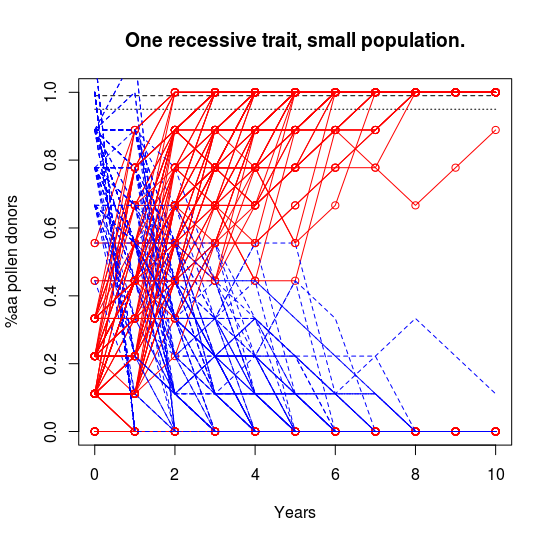
We can extend this simulation to better model a realistic situation where you can only grow a limited number of plants. Coding this is much more complicated. If we run it with a large population, we see a pattern much like the infinite one above. If we run it with a small population, we get very noisy trajectories that vary a lot from run to run. At small population numbers, it is fairly easy to accidentally end the experiment with no "aa" plants to save seeds from. (In real life, we'd just go back to seeds from the previous generation.)

Similar to above figure, but each curve is replaced by a tight cluster of overlapping curves representing individual runs of the simulation.
Population = 1000
Similar to above figure, but each curve is replaced by a loose cluster of overlapping curves representing individual runs of the simulation.
Population =50
Similar to above figure, but each curve is replaced by a very loose cluster of overlapping curves representing individual runs of the simulation. The curves are so noisy that the cluster is spread over much of the plot.
Population =10

The upshot of the simulations is that if we grow small numbers of plants each generation, we can eventually eliminate the pesky dominant alleles for the trait of interest. It will take a while, but it is doable if you're willing to wait several years to a decade.

R Script 2: One recessive trait, small population.
# One recessive trait, small population.
#     Stabilize progeny for recessive trait via selection.
#     Save seeds from double-recessive plants each generation.
years <- 10;
population <- 50; # 1000, 50, 10
trials <- 100;

# Intialize figure.
plot(  c(0,years),c(0,years), col="red", main="One recessive trait, small population.", xlab="Years", ylab="%aa pollen donors", xlim=c(0,years), ylim=c(0,1), axes=TRUE, frame.plot=TRUE);
lines(c(0,years),c(0.95,0.95), col="black", lty="dotted");
lines(c(0,years),c(0.99,0.99), col="black", lty="dashed");

for (ii in 1:trials) {
  # Define F2 population probabilities
  P_AA <- vector();
  P_Aa <- vector();
  P_aa <- vector();
  P_AA <- 0.25;
  P_Aa <- 0.50;
  P_aa <- 0.25;

  # Save seeds only from "aa" plants, which can't self-polinate.
  for (i in 1:(years+2)) {
    # Generate actual population.
    rands <- runif(population, 0, 1);
    Genotypes <- vector();
    for (j in 1:population) {
      if (rands[j] < P_AA[i]) {
        Genotypes <- append(Genotypes, "AA");
      } else if (rands[j] < P_AA[i]+P_Aa[i]) {
        Genotypes <- append(Genotypes, "Aa");
      } else {
        Genotypes <- append(Genotypes, "aa");
      }
    }
    Genotype_counts <- table(Genotypes);
    
    # Determine actual genotype probabilities for pollen donors.
    if (is.na(Genotype_counts["AA"])) {
      P_AA[i] <- 0; } else {
      P_AA[i] <- Genotype_counts["AA"]/(population-1);
    }
    if (is.na(Genotype_counts["Aa"])) {
      P_Aa[i] <- 0; } else {
      P_Aa[i] <- Genotype_counts["Aa"]/(population-1);
    }
    if (is.na(Genotype_counts["aa"])) {
      P_aa[i] <- 0; } else {
      P_aa[i] <- (Genotype_counts["aa"]-1)/(population-1); # The plant we're saving seeds from can't be polinated by itself.  
    }
  
    # Generate new theoretical genotype probabilities.
    P_AA <- append(P_AA,   0);
    P_Aa <- append(P_Aa,   P_aa[i]*P_AA[i]*1.00 + P_aa[i]*P_Aa[i]*0.50);
    P_aa <- append(P_aa,   P_aa[i]*P_aa[i]*1.00 + P_aa[i]*P_Aa[i]*0.50);
    
    P_sum <- P_aa[i+1] + P_Aa[i+1];
    P_Aa[i+1] <- P_Aa[i+1]/P_sum;
    P_aa[i+1] <- P_aa[i+1]/P_sum;
    
    if (is.na(P_Aa[i+1]) == TRUE) {  P_Aa[i+1] <- 0;  }
    if (is.na(P_aa[i+1]) == TRUE) {  P_aa[i+1] <- 0;  }
    
    if (P_aa[i+1] == 0) {
      # End simulation cycle if no "aa" plants.
      for (j in (length(P_aa)):years) {
        P_AA <- append(P_AA,   0);
        P_Aa <- append(P_Aa,   0);
        P_aa <- append(P_aa,   0);
      }
      break;
    }
  }

  # Add current simulation cycle to figure.
  points(0:years, P_aa[1:(years+1)], col="red");
  lines( 0:years, P_aa[1:(years+1)], col="red");
  lines( 0:years, 1-P_aa[1:(years+1)], col="blue", lty="dashed");
}


However, there's a much faster way to complete the process. It might even only take a couple years.

Tomatilloes are perennial where it is warm enough for them to survive through winter. They also easily root from cuttings. These traits combined mean we can pot up rooted cuttings from each plant at the end of one year and continue growing selected plants the next year after we've had a chance to evaluate their fruit characteristics.

You'd have to grow enough plants the first year to be able to find multiple individuals with the recessive traits you're interested in. The next year, you can continue growing only those few plants and allow them to cross-pollinate. Every seed they produce in their second year will contain those recessive traits you selected the parents for. The dominant alleles will be gone from your population.

You're done in one year of selection and another for seed production. No waiting around for a decade or more, gambling with the whims of chance. You may have your new tomatillo variety complete and ready to go.


I didn't talk about dominant traits here. They're a bit more involved and I'll have to do another post about that case. I'll also have to do another post talking about the case where you're looking for multiple specific genes (recessive or dominant) at once.

It looks like my planned two part series is going to be a bit longer in the end.

Thursday, December 5, 2019

Tomatillo Breeding (1/n)

Tomatillos are a wonderful vegetable plant to grow. There are several distinct varieties available, but nowhere near the numbers we see for tomatoes, peppers, or other crops. What's the difference?

Tomatillos are almost exclusively out-breeders. You need two or more plants growing in an area to get good production of fruit. As a result, every plant is a new hybrid and a population will maintain a high degree of genetic diversity. This also makes it difficult for different varieties to be grown in the same area, as they will generally cross and meld into one diverse population.


A few years back I started an experiment with breeding tomatillos. I grew one plant of a variety with small purple fruit next to one plant of a variety with large green fruit. I had saved seeds from a CSA and the local grocer, so I don't have any specific variety names to give you. (If you want to replicate the experiment, the purple variety was similar to: https://www.edenbrothers.com/store/purple-tomatillo-seeds.html; the green to: https://www.edenbrothers.com/store/rio-grande-verde-tomatillo-seeds.html.)

Four tomatillo fruit, from left to right. 1) Medium purple. 2) Small purple. 3) Large green. 4) Medium purple.
#1. Medium purple fruit.
#2. Small purple fruit.
#3. Large green fruit, with purple dots.
#4. Medium purple fruit.
Because the plants are such extreme out-crossers, every seed that year was expected to be a hybrid between the two different varieties. The next year I grew four plants, from seeds I saved from the purple plant. Each plant grew distinct fruit. (1-4, left to right in photo at right.) This diversity tells us that both parental varieties were highly heterogeneous, so the specifics of each hybrid plant depended on exactly which allele they inherited from each parent. As none of my neighbors were growing tomatillos, we can be pretty sure each one was pollinated by the other three.


Two large green tomatillo fruit at right. Six small pale purple tomatillo fruit at left.
F2s from F1#3.

The next year I planted seeds I had saved from plant #3. I grew 11 plants, but only 5 produced any fruit. The plants looked like they'd been exposed to an herbicide from the commercial garden soil I had added to the garden at the start of the season (Herbicide carryover). All the fruit were green, with some later developing some purple pigment as they ripened off the plant.

Ten bowls filled with tomatillo fruit. Contents of each bowl are different sizes and/or shades of green and purple.
F2s from F1#4.
This year I planted seeds I had saved from plant #4. I grew 12 plants and all produced fruit. These showed a much wider range of pigment levels, including a pair of plants with visible purple pigment and large fruit.

One plant had a trait I didn't like at all. The fruit from spoiled very rapidly after picking. (Previous year's fruit stored for months.) That plant was one of two in an isolated garden, so I immediately culled all of the fruit from both plants. I didn't want to risk the genetics associated with spoilage turning up in the garden again next year.

Overhead view of orange plastic bowl filled with large tomatillos. The fruit are combinations of green and dark purple. One fruit at center is mostly green with three purple stripes starting at the bottom.
One plant had fruit I really liked. The fruit were large and developed purple pigment, the traits I have been trying to combine in one plant. I wasn't expecting the fruit to develop stripes as they were maturing, however. These fruit are not lasting as long as I'd like, but the other good traits means I'll be saving seeds from them anyhow.
Overhead view of green plastic bowl filled with medium tomatillos. The fruit are dark purple, with the most ripe looking black..
A couple other plants produced intensely dark purple fruit, appearing ink-black. This is the color I've been looking for, but the fruit aren't as large as I want. I'll save seeds from these as well.

Because the plants are out-crossers, I know they will have been pollinated by the others in the garden. Even though these two have trait combinations I really like, it will be unlikely to find offspring with the same traits because of all the other traits in the garden.

I've tried to diagram the overall history of the project so far. (I didn't have any photos of the original varieties, so they get cartoon representations.)

At top are a small dark purple and large green circle, representing the original varieties I crossed. From the dark circle, a black line goes down to a second row consisting of four tomatillo fruit pictures. (From left to right: medium purple, small purple, large green, & medium purple.) Black lines are drawn from beneath the right two fruit downwards to photos. Left line goes to a photo of 5 bowls of green fruit, with a photo of pale purple fruit to the left. The right line goes to a photo of 10 bowls of fruit with varying colors of purple and green.
Tomatillo project history so far.

About this point I started thinking about how I might get around the issues caused by the potential for genes from every plant in a garden to turn up in the next generation. I don't want to have to cull everything from a garden when something strongly negative turns up in the population. Right now I only have two isolated garden spaces, so that strategy can only go so far.

For my solution, come back in a week for part 2!


References:

Thursday, October 31, 2019

Lavendar

Botanical drawing of lavender plant, showing details of flower structure.
[From link.]
Lavender is a wonderfully aromatic plant with gorgeous flowers. When I moved to Minnesota I learned that most lavenders don't survive our winters well. There are a few varieties listed as surviving here, but they require "some winter protection".

I want lavender to grow and thrive here without care. This led me to start thinking about how I would go about breeding cold-hardy lavenders.


The first step with any breeding project is to figure out a plan. It can be a simple or complex plan, but something. Anyhow. I wanted to gather seeds from the most cold-hardy varieties available. But since I had never actually grown lavender before, I was hesitant to start with buying several relatively expensive plants that I might just kill the first winter.

While investigating the available varieties I realized the most cold-hardy ones were all from the species Lavandula angustifolia and that seeds for L. angustifolia were readily (and cheaply) available in any spring-time seed packet kiosk.

So, I picked up a few packets.


View into small square pot with dark soil and tiny green seedlings.
Lavender seedlings in pot.
This spring I scattered the -tiny- seeds on to the soil in a larger pot, pressed them in, and waited for something to happen. The seeds may have been old, or lavender may not be quick to start from seeds.

Eventually I had some little green seedlings that I didn't recognize growing in the pot. One day I was examining the plants closely, trying to figure out if they were stray weeds or not. To my surprise, I could smell lavender. Even the tiny seedlings are exuberant with their scent production.

Once the seedling had gotten a bit larger, I separated them out and transplanted each one to its own pot. I kept the pots where I could keep an eye on them and keep them watered. A few of the plants began to put on new growth, but most seemed to suffer and remain stunted. (In retrospect, I and our rains may have been keeping them too wet. Oh well, that just counts as a first selection pass. I don't want plants that have to be given special conditions, anyhow.)


Now that winter is coming on, I've brought the three best grown plants inside to overwinter under lights. I left the others to their fate outside in a cold-frame.

Since lavender varieties are propagated by cuttings, I could refer to these three plants as three new varieties. However, only time will tell if they're worth propagating. And really, I don't expect them to have the cold-hardiness that I'm looking for. The odds of one of these three meeting that criterion are astoundingly low.

Lavender plant growing under lights.
Lavender #1.
Short lavender plant growing under lights.
Lavender #2.
Lavender plant growing under lights.
Lavender #3.

I do like the dwarfed growth habit of the second plant. A closer look shows that it does have shorter internode distances than the other plants. It isn't just behind in its growth, it is actually growing differently.

Close view of lavender plant stem leaf.
Lavender #1, stem.
Close view of lavender stem tip on short plant.
Lavender #2, stem.
Close view of lavender plant stem tip.
Lavender #3, stem.
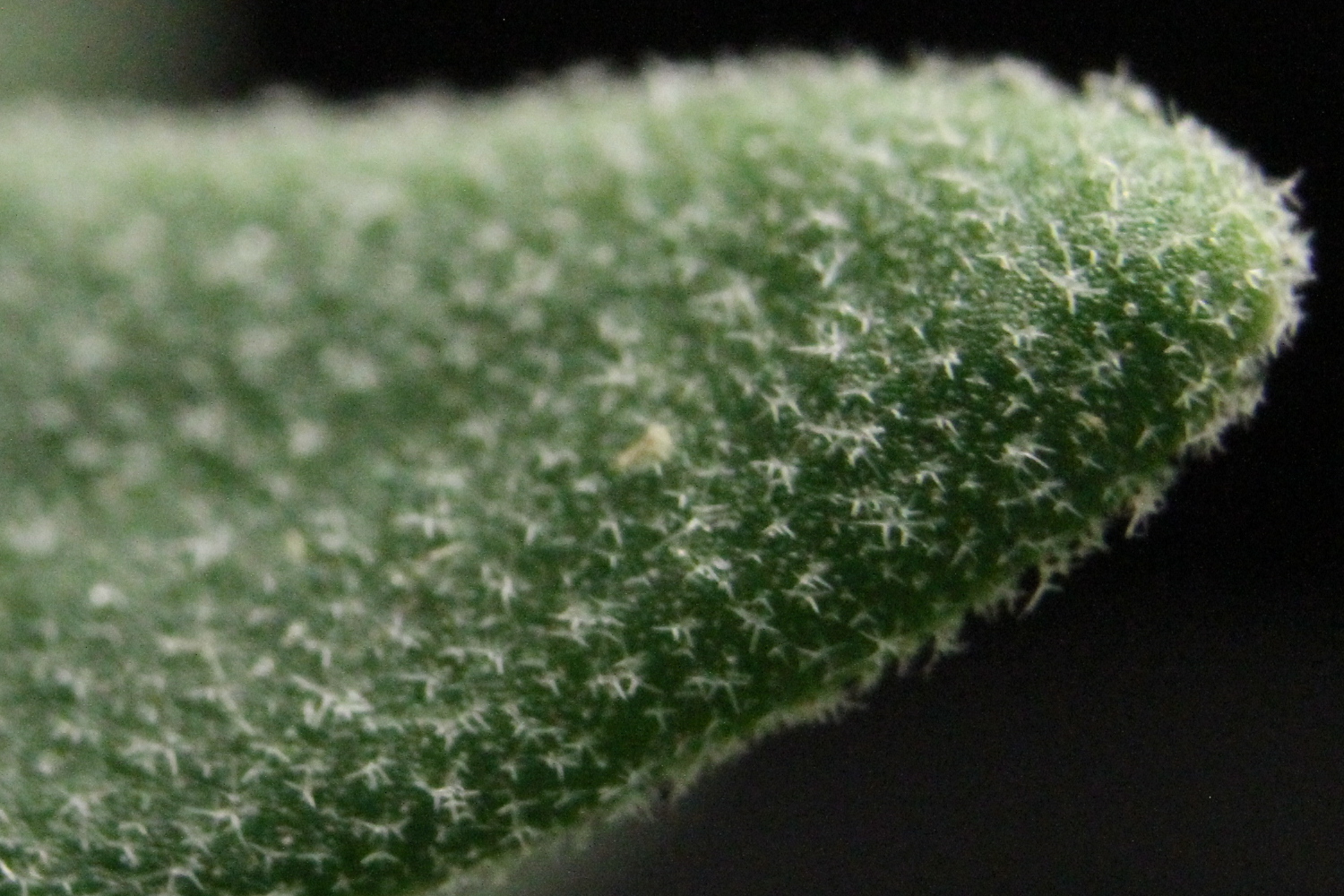
I also like that it looks a bit more silvery than the other plants. A very close up view of some leaf tips shows that the second plant has much more prominent and branched trichomes. These photos were taken hand-held. I think I can probably do better and closer with some more technical preparation (tripod, lights, maybe focus stacking, etc.).

Extreme close up of lavender leaf tip, showing tiny branched trichomes on leaf surface.
Lavender #1, leaf tip.
Extreme close up of lavender leaf tip, showing tiny branched trichomes on leaf surface.
Lavender #2, leaf tip.
Extreme close up of lavender leaf tip, showing tiny branched trichomes on leaf surface.
Lavender #3, leaf tip.


What lessons have I learned and how do they impact my longer term goals?

Lavender varieties are propagated clonally, so there's no need for them to be homozygous for various alleles. As a result, lavender seeds would be expected to contain a surprising amount of genetic diversity compared to domesticated plants that are routinely grown from seed. The few plants I've grown have shown variations in ability to prosper in the temperature/water conditions I was growing them in, as well as having height and trichome differences.

I have no reason not to expect variations in cold hardiness will also be manifest when I grow out a larger population, though I don't expect one of these three to be a winner in that regard. I'm also looking forward to what other interesting traits may turn up.

The next steps are to acquire a larger number of seeds, grow more seedlings, then plant them out for winter. For initial hardiness trials, I can have many small plants in my back yard. If I find survivors, I'd want to collect seeds and begin the cycle again. Later I can plant seedlings or cuttings at a family property further north. Ideally, I would eventually find trial space in the far north of Minnesota, so the plants can be tested against the coldest that Minnesota winters can provide. That would be several years out, so I have some time yet to make arrangements if things develop such that they would be useful.


Why?

Funny you should ask. In the medium-term, I'm simply motivated by the desire to play around with the plant and produce something I can grow in my yard without having to spend too much effort at keeping it alive. In the long-term, I want to produce varieties that can be farmed for fragrance production in Minnesota. (All current lavender farms in USA are a few growing zones warmer than is available here.) This would open up a new crop for local agriculture and help to diversify what is grown in the state. I don't know if this will come to pass, but that's the thing about long-term goals.


References:

Monday, October 1, 2018

The Color of Beans

I've been looking for some blue-colored beans for several years. Its easy to find beans in a range of colors (red, pink, white, yellow, green, black), but blues are a rarity in beans. Early on I found an Italian bean called "Nonna Agne's Blue Bean", but the only seller in my country was out of stock. Sometime along the way I received an offer of some French heirloom blue beans via a facebook connection, but no seeds ever appeared. (She offered them for free, so I can't complain too much.) Blue beans are around, but they're rare.

Three black dry beans, with an almost bluish shine in the light.
Last year I received some beans from an online collaborator after I had mentioned my interest in blue beans. She said one of her plants that season had turned out to be an unexpected hybrid that produced blueish seeds. The three seeds that arrived are shown at left. To my eye they were basically black, but with maybe the slightest blue cast. I wasn't optimistic, but after the difficulty I'd had finding blue beans I was going to give them a try.

Square plastic pot with two bean seedlings.Two of those three beans sprouted. This was kinda a dramatic time, as those two sprouts could easily have died and then another possible blue bean lead would have gone nowhere. Fortunately, both plants thrived.

Mixed dry beans in shades of dark blue, brown, and a color in between that looks like a dark grey..A few months later I had a small pile of new beans. When I started shelling them I was very pleased to see some distinctive blue color. As the beans age and dry down, they start to produce some tan pigment which muddies up the pretty blue.

Next spring I'll plant enough of the more blue beans so I can grow enough to make a few meals of them. Right now I have too few to make a meal and have enough for planting.


How did I know that the biology of bean color should be able to produce a blue bean? The red color of beans is due to a group of biological pigments called anthocyanins. This same group of compounds is also responsible for the rare blue pigments we see in biology.

An analysis of black beans showed most of the anthocyanins to be delphinidin (at 56%), with lesser amounts of petunidin and malvidin (26% and 18%, respectively). Delphinidin and malvidin are responsible for blue color in various flowers. The petunidin is described as having a dark-red/purple color. All together, this suggests that black beans really are just super-dark blue beans. This is corroborated by references I've heard of black beans crossed to white beans sometimes producing distinctly blue beans in among the progeny.

So, why are blue beans so rare? I got nothing that explains it. Blue is such a lovely and generally rare color that I would have thought people would have been growing blue beans as much or more than the now-common red beans. Maybe I can help rectify the situation in time.


As I was writing this post I decided to look around again for vendors selling blue bean varieties. I found a European vendor that seems to have stock of the Italian "Nonna Agne's Blue Bean". I also found another unrelated blue variety called "Blue Shackamaxon Pole Bean". I might think about ordering some of each, but it'd be more fun to make my own now that I've got a start at it.


References:

Thursday, April 5, 2018

The Naming of Things

If you've been following me here for a bit, you've probably noticed I'm interested in plant breeding (especially garden veggies). My main goals are to have healthy plants that grow and produce well for me with minimal inputs in my short-season climate. The measure of, "tasty" I go by is what tastes good to me and my family, with what other people consider tasty (when I occasionally do taste-tests) held to a lesser significance.

Two large cherry sized, blocky, white tomatoes. They're sitting on a notebook with a sketched map of the garden, showing where all the plants are and which plants were grown from the same batches of seed. There is a blue pen pointing at the specific plant which produced the fruit.
From 2017, with garden notes.
I've been working with tomatoes for several years and have developed some more fine-tuned ideas about what I want the plants to become. One of my lines, seen at right, is approaching stability. That is to say, most plants from one year to the next produce very similar fruit. The fruit are blocky, large-cherry sized, white (well, paler than yellow) in color, and have a very thick outer fruit-wall (not the skin). They've tested well with people in and outside my immediate family, so I've been thinking about the possibility of distributing their seed in the future.

A few dozen of the large white cherry tomatoes sitting on a white plastic cutting board.
From 2016.
In my personal notes, I've been using the rather uncreative name of, "Abbey White" for these tomatoes. It is sufficiently descriptive to let me know what I'm talking about in my notes, but it isn't a name I expect to attach to the variety when/if I start distributing it. I could easily adjust it to, "Abbey's White", but I'm not sure I want to go with that either.

In the forground is a ceramic bowl filled with diced white tomatoes. In the background is a large wooden cutting board covered in white, yellow, and orange tomatoes (as well as a few green tomatilloes).
From 2016.
"Wait. Tomatoes are red, right!?" A white tomato might seem kinda unusual, but it's just one of a very wide spectrum of colors that tomatoes can be found in. (Check out these companies I have no affiliation with: Artisan Seeds, Baker Creek Heriloom Seeds, TomatoEden, and SeedSavers Exchange. There's so much more diversity in color and taste available if you're willing to grow tomatoes from seed.) My tomatoes tend to be any color but red. Red fruit that have turned up in my garden have tended to have a taste I didn't favor, so over a few years I stopped growing as many red tomatoes. I expect I'll need to bring in some new genetics before I can grow red tomatoes that will taste good to me.


While I was thinking about how to go about naming this variety (and others in the future), I came across twitter user @JanelleCShane. She's been playing with Recurrent Neural Networks (basically a type of AI (specifically a type of machine learning)) trained on diverse datasets, like fruit names (or knitting patterns (or Irish melodies)), so I tweeted:

(I only later noticed my garbled grammar.) I was somewhat surprised when she responded back, asking if I had a list of tomato variety names she could train her AI with. I didn't, but I was pretty sure I could pull one together pretty quickly from online resources. After some looking, I found several sources ([1], [2], [3], [4], [5], [6]) with large lists of tomato variety names. To avoid spending too much time gathering the names, I wrote web scrapers to process each source and output text files with lists of names. In total, across the six sources, I collected 11,719 distinct tomato variety name strings. Some may represent extinct varieties. Some are in other languages. Some are numerical codes. There's also capitalization and spelling variations. I threw them all into a file that Janelle could use to train her AI.

Have a look at her blog post on the tomato name trained AI at: http://aiweirdness.com/post/172622965862/tomatonames


So. What did the trained AI come up with? Well, at first the AI got overly fascinated with the numerical code names in the training dataset. It produced lots of new "names" that would be quite not useful for naming a new variety. Janelle stripped out most of the code names from the list and trained the AI again.

This time there were some really good results, some really wrong results, and all sorts of weirdness in between. I've highlighted some of my favorites from each category.

The Good,the Weird,and the Wrong.
  • Floranta
  • Sweet Lightning
  • Speckled Boy
  • Flavelle
  • Market Days
  • Fancy Bell
  • Pinkery Plum
  • Mountain Gem
  • Garden Sunrise
  • Honey Basket
  • Cold Brandy
  • Sun Heart
  • Flaminga
  • Sunberry
  • Special Baby
  • Golden Pow
  • Birdabee
  • Sandwoot
  • Bear Plum
  • The Bango
  • Grannywine
  • Sun Burger
  • Bungersine
  • First No.4
  • Smoll Pineapple
  • The Ball
  • Golden Cherry Striped Rock
  • Eggs
  • Old German Baby
  • Frankster Black
  • Bumbertime
  • Adoly Pepp Of The Wonder
  • Cherry, End Students
  • Small Of The Elf
  • Champ German Ponder
  • Pearly Pemper
  • Green Zebra Pleaser
  • Flute First
  • Speckled Garfech
  • Green Dork
  • Cluster Gall
  • Shirve’s Gigant Bullburk
  • Giant Ballsteak
  • Black Crape
  • Brandywine, True Grub
  • Caraball
  • Ranny Blue Ribber
  • Roma Wasting Star
  • Scar Giant
  • Bug Beauty
  • Banana Placente
  • Bananana
  • Stoner
  • Speckled Bake
  • Ruck
  • Green Boor
  • Wonder Bagg
  • Sun Bung
  • Bellende
  • Shart Delight
  • Solad Piss


There were also a collection that would fit perfectly among the real tomato names, though they'd be kinda strange in other contexts.
  • Matt's Sandwich
  • Indigo Tree
  • Striped Hollow Potato Leaf
  • Lelly's Yellow Stuffers
  • Terra Pink Strain
  • Greek Boar
  • Ton's Oxheart
  • Babla's German Paste
  • Mortgage Lifter, Honey Blues

I really like when the AI tried to name a tomato after a person. It didn't have enough examples for real human names, but it gave it a good solid try.
  • Matt's Sandwich
  • Lelly's Yellow Stuffers
  • Ton's Oxheart
  • Babla's German Paste
  • Shirve’s Gigant Bullburk

Amusingly, the AI came up with an existing name that wasn't in the training dataset. "Sunberry" is the name of another fruit. It's a close relative of the tomato, so I think I'll call that a positive score for the AI.


Do any of these names fit my tomato? I'm not sure. I do rather like, "Flavelle" and, "Mountain Gem". I'll probably have to let the ideas ferment a while before I come to a decision.

I have recently seen a tomato that the name, "Speckled Garfech" would be perfect for. It came out of someone else's breeding program, so I won't share a photo. Imagine a yellow/orange striped tomato covered in green spots.
Two photos combined. The top half is a photo of a large yellow ceramic bowl filled with small cherry tomatoes. The cherry tomatoes area a mix of white and pale orange with a pink blush on one end. The bottom half is a photo of a closeup of a single larger tomato that is white with pale dark stripes. There are smaller red tomatoes and other items in the background.
From 2017.

I've got a couple more tomato lines that I'd like to stabilize (photographs at right). The upper photo shows a mix of small, very sweet cherries in pale-yellow/white with a pink blush on the bottom end of some. I'll be growing seeds from the ones with the blush. I expect the same phenotype will turn up next year, but I'm also sure there are lots of recessive alleles still hiding in them (for larger fruit, other tastes, and not having the blush).

The lower photo is of a larger, meaty white with pale stripes. This one is a bit further along already thanks to some lucky genetics, even though this phenotype only appeared in the last year. The fruit color, size, and shape are all due to recessive alleles, so those traits should already be stable. The stripes, flavor, and plant growth details probably won't be stable yet. I'll be growing several seeds from this fruit this year to find out.


References: