// Twitter Cards // Prexisting Head The Biologist Is In: selection
Showing posts with label selection. Show all posts

Tuesday, May 10, 2016

Making My Own Carrots 5

I've been thinking about what my plans are for the carrots I've been working with. Because it is a biennial crop, I can split the project into two distinct directions. Alternating, growing the seeds from one project and the other.

Two dark pink carrot halves, resting upright. One has leaves starting to grow from the top.
1. Blush carrots.
I really liked the purple-blushed roots (fig 1.) that turned up in my first generation population. By comparing to the parental types, these were obviously hybrids between "Cosmic Purple" (which have a thin layer of anthocyanin-purple skin over an orange core) and one of "Solar Yellow" or "Lunar White". I initially was sad that I wouldn't be able to stabilize this really pretty color combination because it was a hybrid. Today I realized there is a way to develop a [more or less] stable variety with this color scheme.

Cartoon figure illustrating the result of a white-fleshed and orange-fleshed carrot crossing to produce a white-fleshed hybrid.
2. Production of F1.
The F1 (fig 1 & 2.) shows us the intensity of purple skin pigment is incompletely dominant. One copy of the allele gives the blush skin color and two gives the full purple skin color. (This gene acts like the "P1" mutation.) The F1 also shows us that the white flesh trait is dominant to the orange flesh trait. (Acting like one of the carotenoid inhibitors named with "Y".)

Cartoon figure illustrating F2 carrot population, with a quarter of the potential resulting plants having orange flesh.
3. F2 population.
With these genes driving the colors, we can predict what the F2 population would look like (fig 3.). 25% of the population will have orange flesh; 75% will have white flesh. 25% will have dark-purple skin; 25% will have clear skin; 50% will have blush-purple skin. (Hopefully 25% will be sweeter, like "Cosmic Purple" was compared to "Lunar White". The F1 wasn't terribly sweet of a carrot.)

Over several generations of selecting roots with white-flesh and blush-purple skin, the proportion of the recessive orange-flesh trait will diminish slowly. If I use a small number of roots for each parent generation, the likelihood of losing the orange trait would be better. (I could use "Power Breeding" to help ensure the loss of the recessive trait.) Eventually, I would end up with a new "stable" variety that would consistently be 50% the blush-purple color I found so attractive. (If the blush-purple color were to look really nice on an orange carrot, I could easily stabilize that trait even faster since orange is the recessive trait.)

Thinking through the genetics like this is making me less annoyed that all the odd little hybrid roots I saved from last year ended up not surviving. The large orange/yellow hybrid root also rotted out, so my second generation parent population is already reduced to just the two blush-carrots in fig 1. These two roots are basically identical, so them crossing would essentially be the same as selfing a F1 hybrid. They're both growing new roots and greens, so I'm pretty confident I can keep them alive until they produce seeds.

While they're growing for seed production, I can also grow a whole new diverse population from saved first generation seed. Then I'll get to determine some other selection criteria for a second carrot variety. Oooh! I can even add in some of the lycopene-red "Atomic Red" carrots (the ones that didn't make it the first year) to this year's population. This would let me try again to get that lovely color in my alternate-year carrot variety.


References:

Tuesday, March 22, 2016

Making my own Carrots 4

I've been breeding my own carrots over the last few years. Because carrots have a biennial life-style (growing roots the first year and flowering the second), it takes an extended time to see any results of your work. My main goal has been to breed up a locally-adapted mix of carrots enriched with red and purple shades.

The basic outline for the project:
  • [2013] Grow mixed varieties of carrots, including as many intensely colored forms as can find. Select roots for diverse color and vigor.
  • [2014] Roots selected for survival in fridge. Grow final selections for flowering; allow open crossing; save seed.
  • [2015] Plant seed densely. Select for apparent F1 hybrids, vigorous roots with colors intermediate between parent types.
  • [2016] Roots selected for survival in fridge. Grow final selections for flowering; allow open crossing; save seed.
  • [2017] Grow (F2) carrots, eat carrots, enjoy life. Make selections.
  • [2018] Grow selections to flowering.
  • Cycle the steps for the last two years until project is 'complete'.

I planted "Atomic Red" carrots into the original mix, but at the end of the first growing season I had no roots with the pretty lycopene-red color of the variety. I also planted "Cosmic Purple" carrots, which have a thin layer of anthocyanin-purple skin over a more typical orange core (giving an overall purplish look), didn't do well in my garden and survived winter storage poorly. "Solar Yellow" and "Lunar White" carrots did very well in the garden and in storage. Orange "Bambino" carrots also did reasonably well.

My first parental generation of carrots was 3 "Solar Yellow", 3 "Lunar White", 4 "Cosmic Purple", 1 "Bambino", and 1 "Purple Haze" (I think. I picked it up from a farmer's market). Two or three of the "Cosmic Purple" plants decided not to bloom, so the final population was heavier on genetics for white and yellow than I had originally planned.

1. White and yellow mess.
I didn't take any useful photos of the next generation plants during the growing season. The planting grew stridently and produced some really large roots, along with many smaller ones. We didn't thin the planting sufficiently, but we got way more mass of carrots than we could eat. (Nearing the end of March now, I'm still giving carrots to friends.) This first generation from saved seed ended up being mostly various yellow and white shades, but there were enough colorful roots to keep the project moving forward.

2. Purple blush hybrids.
Several of the roots that survived storage into 2016 are obviously hybrids. Three large roots had "Cosmic Purple" as a parent, with "Solar Yellow" or "Lunar White" being the other parent. These roots (in image 2) are pale in color, with a blush of anthocyanin-purple covering the surface. I was struck by how pretty these roots were when I first pulled them out of the ground.

3. Orange/yellow hybrid.
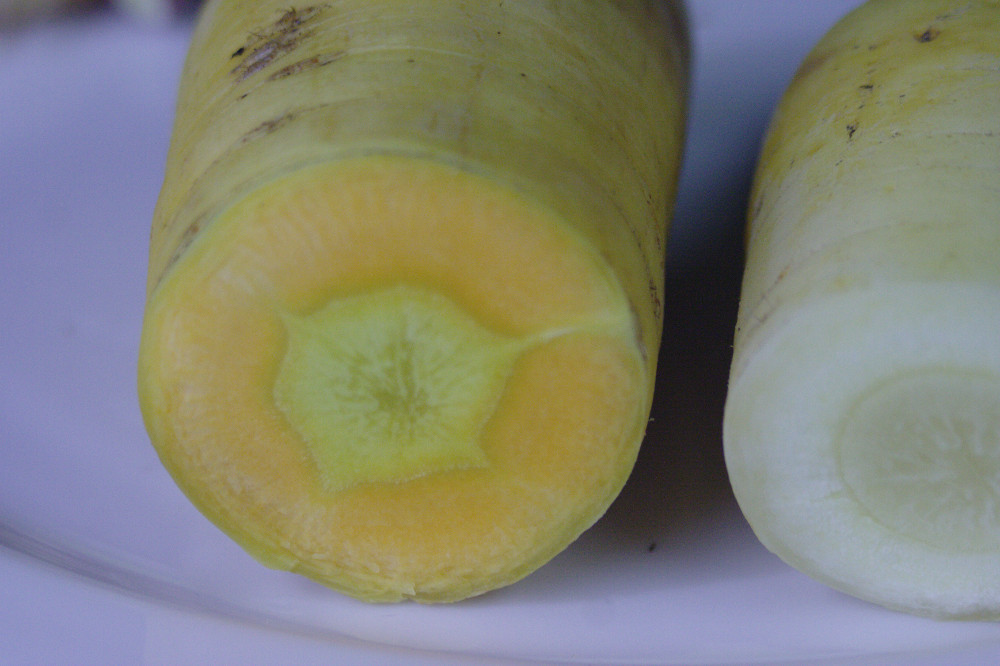
One large root has a yellow core and an orange medulla (at left in image 3), a combination of colors not found in any of the parent varieties. I suspect this one had "Bambino" and "Solar Yellow" as parents. I only found one root with this color combination.

4. Small hybrids.
Among the smaller roots that appeared to be hybrids, there is a mix of traits. One root appears to have a purple medulla (like "Purple Haze"), but clear/white skin. (The second from the left in bottom of image 4.) One root has a purple skin (like "Cosmic Purple"), but has white flesh. (The left in top and bottom of image 4, compared to "Purple Haze" at the right end of the top.) A few others have the same purple skin, but have flesh showing a gradient between white and orange. Some of these roots are obviously alive and growing new greens, but for some of the most interesting ones it remains unclear if they will be able to contribute genetics to the next generation.

5. Preparing for growth.
I've put all the hybrids in water and under light. I hope that some of the more interesting hybrids wake up and show some new green growth.

The reason I'm so focused on the obvious hybrids is because by virtue of them being hybrids, they're heterozygous for genes involved in the formation of interesting colors. In the next generation of seeds produced from crossing these plants, there will be all sorts of interesting segregants. What this means to non-biologists is that the next generation of carrots will include both very light and very dark colored specimens.


References:

Tuesday, August 4, 2015

Novel Vegetable: Black Raddish

Lately I've been writing a series of posts about plants I found on a trip to central Alaska (the-biologist-is-in.blogspot.com/search/label/Alaska). I realized last night that I had enough posts on the topic written up or planned to fill out much of the next few months at my every-Tuesday-plan. So instead of this becoming the Its-Tuesday-Alaska-Time blog, I'll swap posts on other topics into the schedule as I see fit. I might even double up and push through more than one Alaska post a week. We shall see.


On a whim, this year I grew a patch of black radish from seed ordered online. Some time after ordering, the radish seeds and those for a few other root vegetables arrived in a package with Slovenian postage. I had no idea I was ordering from Slovenia. You can end up ordering from surprising places sometimes.

As our garden was still being built, I didn't have a place to grow the radish until a couple of good friends stepped up and donated the space in one of their garden beds for the season for several experimental vegetables.

The radish plants started up quickly and thrived, producing lots of huge green leaves. I had read that they were a larger and longer-season type of radish than the typical small-red radish I find in local stores. I wasn't sure when to harvest the roots, so I let them go (and grow) until they [the plants] told me it was time. On recent trips to the garden, I noted more and more of the plants have been bolting. Each time I pulled out the flowering plants, to prevent any early-flowering genetics from making it into the next generation. I tried eating some of the culled roots and found them to be very pungent, but also somewhat wooden. I know radishes become less ideal as food when they start blooming, so perhaps I should have culled a random good plant for sampling instead.

I finally gave in and harvested what remained of the crop a few days ago (27-July-2015). There were many small-rooted plants in the mix, which I promptly discarded so to select out the loser genetics they represented. (The plants that didn't fight their way to the top aren't the ones I want to save seed from, even if they could have done much better with more thinning.) As I was pulling the plants out, I realized a minority of the population had developed a lovely purple color on their stems. The photo at right shows the result of my rough sorting of the plants by size and color as I went.

The purple-colored plants didn't produce the largest roots, which was one of my final selection criteria, but I decided I really wanted the color mixed into the next generation. I chose two of the most colorful plant, as well as two of the largest rooted plants, for my final population to produce seed for next year.

All four plants have been replanted in a large pot, where they can mature further. The plants look really sad right now, but I'm confident that they will recover and produce a batch of seeds.

All of the sizable culled roots went to a neighbor of the host gardener. She is using them to prepare a lacto-fermented condiment that is somewhat similar to sauerkraut. The root is relatively fibrous and highly pungent, leading to it best being used like one would use horseradish. The grating and fermentation will break up the fibers and temper the pungency somewhat. This is a traditional European recipe from the era before refrigeration and is one of the ways black radishes are typically used where they are more commonly grown in Europe.

After looking into radish recipes a bit, I'm thinking about making chips from the black radish next year. As you might imagine horseradish chips would be a problematic food item, I expect black radish chips will take a few trials to get right.


References: