// Twitter Cards // Prexisting Head The Biologist Is In: carrots
Showing posts with label carrots. Show all posts

Thursday, September 1, 2016

Making My Own Carrots 6

Two carrot roots, pale pink with darker pink tops. Bottom half of root was cut away and remaining top is sitting upright. One has new green leaves.
The only surviving roots.
My ongoing project to breed my own carrot variety had a couple of unexpected twists this year. At the end of last year I saved all the roots which appeared to be grown by F1 hybrid plants. Such roots were the most interesting to me because they were the ones that could later produce diverse F2 seeds. I was most pleased with the ones that had some purple or red coloring, since I want my carrot population to be full of rich red/purple colored roots in later years. Most of the roots seemed to make it through winter, but when I warmed them up this spring to start growing, most proceeded to rot. This left me with only two large roots that had a lovely blush color (at right). Two plants is a limited genetic pool to work with, but I figured it would be fine because they were both F1s.

During the growing season, one of these potential mother plants bloomed and seeded furiously. The second potential mother plant grew luxuriantly, but decided not to bloom at all. My population has gone through a severe genetic bottleneck. One individual.

Two large pots of carrot plants on balcony.
The sterile and floriferous mother plants.
Fortunately, this one plant is a F1 hybrid, so it is likely to have a relatively high amount of genetic heterozygosity. One of the parents was likely an intense red/purple, while the other was likely pale/white. White roots are generally a dominant trait over orange in carrots, but it seems the red/purple trait has a co-dominant expression pattern. The result of this is the next generation of carrots will likely have a widely diverse mix of phenotypes for me to select from, even with the genetic population having been reduced down to one individual. Next year, I plan to save many more roots to minimize the chance of this happening again.

I'll try to keep the non-blooming plant alive over this next winter. Maybe it will flower next year, maybe it won't. Either way, I won't be allowing its genetics to contaminate my main carrot breeding project. If it lives long enough and grows monstrous enough...  I might decide to initiate a new carrot breeding project. We shall see.


References:

Tuesday, May 10, 2016

Making My Own Carrots 5

I've been thinking about what my plans are for the carrots I've been working with. Because it is a biennial crop, I can split the project into two distinct directions. Alternating, growing the seeds from one project and the other.

Two dark pink carrot halves, resting upright. One has leaves starting to grow from the top.
1. Blush carrots.
I really liked the purple-blushed roots (fig 1.) that turned up in my first generation population. By comparing to the parental types, these were obviously hybrids between "Cosmic Purple" (which have a thin layer of anthocyanin-purple skin over an orange core) and one of "Solar Yellow" or "Lunar White". I initially was sad that I wouldn't be able to stabilize this really pretty color combination because it was a hybrid. Today I realized there is a way to develop a [more or less] stable variety with this color scheme.

Cartoon figure illustrating the result of a white-fleshed and orange-fleshed carrot crossing to produce a white-fleshed hybrid.
2. Production of F1.
The F1 (fig 1 & 2.) shows us the intensity of purple skin pigment is incompletely dominant. One copy of the allele gives the blush skin color and two gives the full purple skin color. (This gene acts like the "P1" mutation.) The F1 also shows us that the white flesh trait is dominant to the orange flesh trait. (Acting like one of the carotenoid inhibitors named with "Y".)

Cartoon figure illustrating F2 carrot population, with a quarter of the potential resulting plants having orange flesh.
3. F2 population.
With these genes driving the colors, we can predict what the F2 population would look like (fig 3.). 25% of the population will have orange flesh; 75% will have white flesh. 25% will have dark-purple skin; 25% will have clear skin; 50% will have blush-purple skin. (Hopefully 25% will be sweeter, like "Cosmic Purple" was compared to "Lunar White". The F1 wasn't terribly sweet of a carrot.)

Over several generations of selecting roots with white-flesh and blush-purple skin, the proportion of the recessive orange-flesh trait will diminish slowly. If I use a small number of roots for each parent generation, the likelihood of losing the orange trait would be better. (I could use "Power Breeding" to help ensure the loss of the recessive trait.) Eventually, I would end up with a new "stable" variety that would consistently be 50% the blush-purple color I found so attractive. (If the blush-purple color were to look really nice on an orange carrot, I could easily stabilize that trait even faster since orange is the recessive trait.)

Thinking through the genetics like this is making me less annoyed that all the odd little hybrid roots I saved from last year ended up not surviving. The large orange/yellow hybrid root also rotted out, so my second generation parent population is already reduced to just the two blush-carrots in fig 1. These two roots are basically identical, so them crossing would essentially be the same as selfing a F1 hybrid. They're both growing new roots and greens, so I'm pretty confident I can keep them alive until they produce seeds.

While they're growing for seed production, I can also grow a whole new diverse population from saved first generation seed. Then I'll get to determine some other selection criteria for a second carrot variety. Oooh! I can even add in some of the lycopene-red "Atomic Red" carrots (the ones that didn't make it the first year) to this year's population. This would let me try again to get that lovely color in my alternate-year carrot variety.


References:

Tuesday, March 22, 2016

Making my own Carrots 4

I've been breeding my own carrots over the last few years. Because carrots have a biennial life-style (growing roots the first year and flowering the second), it takes an extended time to see any results of your work. My main goal has been to breed up a locally-adapted mix of carrots enriched with red and purple shades.

The basic outline for the project:
  • [2013] Grow mixed varieties of carrots, including as many intensely colored forms as can find. Select roots for diverse color and vigor.
  • [2014] Roots selected for survival in fridge. Grow final selections for flowering; allow open crossing; save seed.
  • [2015] Plant seed densely. Select for apparent F1 hybrids, vigorous roots with colors intermediate between parent types.
  • [2016] Roots selected for survival in fridge. Grow final selections for flowering; allow open crossing; save seed.
  • [2017] Grow (F2) carrots, eat carrots, enjoy life. Make selections.
  • [2018] Grow selections to flowering.
  • Cycle the steps for the last two years until project is 'complete'.

I planted "Atomic Red" carrots into the original mix, but at the end of the first growing season I had no roots with the pretty lycopene-red color of the variety. I also planted "Cosmic Purple" carrots, which have a thin layer of anthocyanin-purple skin over a more typical orange core (giving an overall purplish look), didn't do well in my garden and survived winter storage poorly. "Solar Yellow" and "Lunar White" carrots did very well in the garden and in storage. Orange "Bambino" carrots also did reasonably well.

My first parental generation of carrots was 3 "Solar Yellow", 3 "Lunar White", 4 "Cosmic Purple", 1 "Bambino", and 1 "Purple Haze" (I think. I picked it up from a farmer's market). Two or three of the "Cosmic Purple" plants decided not to bloom, so the final population was heavier on genetics for white and yellow than I had originally planned.

1. White and yellow mess.
I didn't take any useful photos of the next generation plants during the growing season. The planting grew stridently and produced some really large roots, along with many smaller ones. We didn't thin the planting sufficiently, but we got way more mass of carrots than we could eat. (Nearing the end of March now, I'm still giving carrots to friends.) This first generation from saved seed ended up being mostly various yellow and white shades, but there were enough colorful roots to keep the project moving forward.

2. Purple blush hybrids.
Several of the roots that survived storage into 2016 are obviously hybrids. Three large roots had "Cosmic Purple" as a parent, with "Solar Yellow" or "Lunar White" being the other parent. These roots (in image 2) are pale in color, with a blush of anthocyanin-purple covering the surface. I was struck by how pretty these roots were when I first pulled them out of the ground.

3. Orange/yellow hybrid.
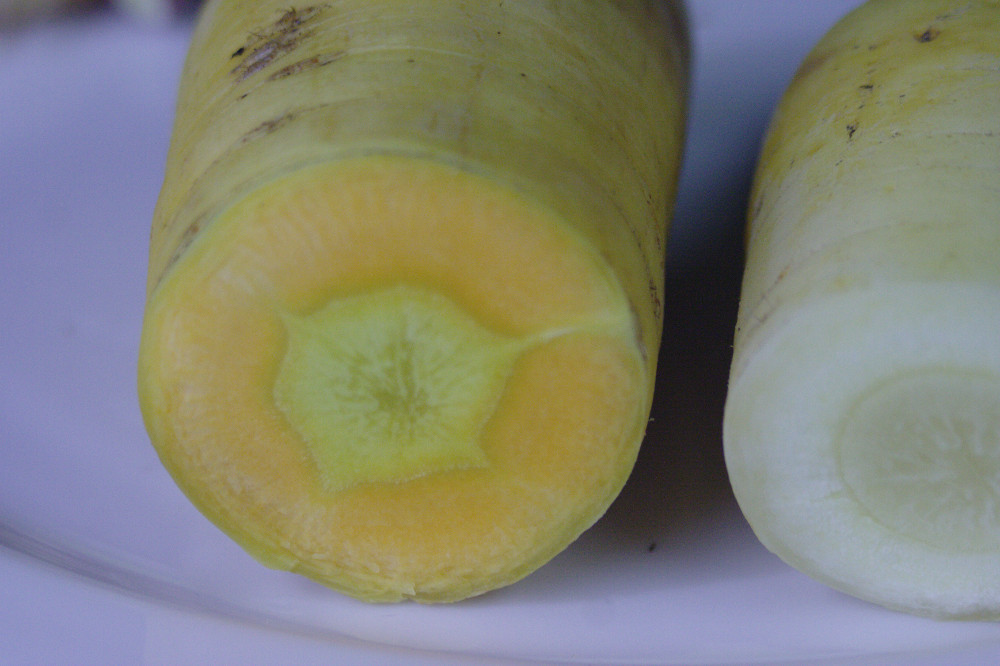
One large root has a yellow core and an orange medulla (at left in image 3), a combination of colors not found in any of the parent varieties. I suspect this one had "Bambino" and "Solar Yellow" as parents. I only found one root with this color combination.

4. Small hybrids.
Among the smaller roots that appeared to be hybrids, there is a mix of traits. One root appears to have a purple medulla (like "Purple Haze"), but clear/white skin. (The second from the left in bottom of image 4.) One root has a purple skin (like "Cosmic Purple"), but has white flesh. (The left in top and bottom of image 4, compared to "Purple Haze" at the right end of the top.) A few others have the same purple skin, but have flesh showing a gradient between white and orange. Some of these roots are obviously alive and growing new greens, but for some of the most interesting ones it remains unclear if they will be able to contribute genetics to the next generation.

5. Preparing for growth.
I've put all the hybrids in water and under light. I hope that some of the more interesting hybrids wake up and show some new green growth.

The reason I'm so focused on the obvious hybrids is because by virtue of them being hybrids, they're heterozygous for genes involved in the formation of interesting colors. In the next generation of seeds produced from crossing these plants, there will be all sorts of interesting segregants. What this means to non-biologists is that the next generation of carrots will include both very light and very dark colored specimens.


References:

Tuesday, August 25, 2015

Making My Own Carrots 3


I've previously posted about my project to breed up my own variety of carrots (the-biologist-is-in.blogspot.com/2014/02/making-my-own-carrots.html) and showed you some photos of the flowers (the-biologist-is-in.blogspot.com/2014/05/making-my-own-carrots-2.html) growing from the mother plants I had selected the previous year and saved over the winter.

I was looking through my photo archive and realized I had taken some photos (left and right) of a couple "mother" plants that decided not to flower with all the others in the second year. Instead they grew lumpy and tortured looking over the year and froze in their second winter. I figured someone might be interested in seeing them, since few people these days will have experience growing carrots beyond the first year.

Perhaps these roots would have bloomed in their third year. Perhaps they would have bloomed in their second if they had been exposed to some environmental trigger lacking in their second year. These were the darkest purple roots I had saved, so the large batch of seed resulting from all the flowers has fewer of those nice intense color genes than I had hoped for in the project. However, I'd rather not have the genetics responsible for the lack of flowers in my carrot population.


This year a friend is hosting an aggressively growing patch of carrots in her garden. I didn't have a garden setup yet and the seeds had to get planted.

I pulled out several sample carrots at midsummer to check on their growth and edibility. I also pulled out some samples of the variety "Scarlet Nantes" to use as a flavor control, since it is known for being a very sweet carrot. My carrots didn't taste very sweet, but the control carrots tasted horrid. I'm blaming the then-hot weather on the poor showing they all had in the flavor department.

The carrots had a range of colors, ranging from white to yellow, orange, pink, and red. There was even a couple roots that seemed to have a thick translucent outer layer (with pink pigment throughout). The reddish ones tasted the worst and the translucent-surface ones tasted the best.

I'll be taking lots of photos and statistics of the larger batch when harvest time comes at the end of fall. Soon after I'll be writing up a nice post with lots of pretty pictures. Somewhere along the way I'll have to decide what selection criteria to have for the next generation.


Part 1: The initial story.
Part 2: Carrot flowers.

Tuesday, August 18, 2015

Wild Carrot Flowers

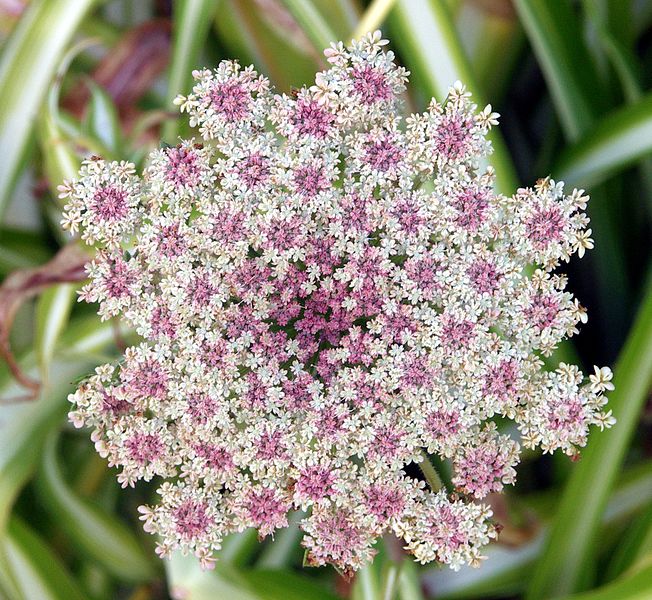
Wild Carrot (Queen Anne's Lace, Daucus carota) is a common roadside weed/wildflower. The typical flower structure is a flat umbel with hundreds of tiny flowers. The florets at the edge have larger petals on their outer sides. Some of the plants produce a small number of dark purple florets (usually just one) in the center of the umbel, but it isn't clear why it does so. The purple florets are considered sterile (though this photo suggests not always), so there has to be some selective advantage to having them that maintains their presence in the population. Some suggest the dark floret acts as an insect mimic to draw in flying pollinators, but the research is ambiguous at best.

While was taking photographs of one plant, an ant climbing across the surface of one umbel paused to investigate the dark center floret. This started me wondering if the plant might have improved pollination from ants crawling across it with the dark purple center to attract them. More generally, the dark floret could act as a nectar-guide to draw bees and other effective pollinators to the umbel. The impact on insect visitation (and presumably on fertilization) of dark marks has been shown for other plants, so it is reasonable to extrapolate the same adaptive role may be at play in the wild carrot.

Once the dark central floret drew my attention, I looked for variations in the trait within the small population I was walking along. The most pronounced difference I noted was in the height and size of the central floret. In most plants the central floret was held at the same level of all the others. In some few it was held below and in one, a larger central floret was held well above the other florets in the umbel. I thought this was an attractive variation, so I harvested a near-mature seed-head from the plant. I might grow a plant or two in a controlled location some time -- when I'm not trying to get seed from edible carrots (they readily hybridize), that is.

I also noted some variation in color of the central floret. The typical example is a very dark purple, but I also found a few plants with a much lighter pink central floret. I don't really like the aesthetics of the photo at right, but it was the best I got when trying to place the two different colored central florets next to each other for comparison.

The diversity of variations of the central floret in this small population suggest that the trait isn't under strong selection (at least in this small population). If a trait is under strong positive selection, mutations which interfere with it will rapidly be lost. To me, this suggests the dark central floret is a historical anachronism. It was once under strong positive selection, which is why it is so common, but it is not now under such selection (again, at least in the small population I examined). This could mean that in whatever small corner of the world where the plant came from, there is a specialized pollinating insect that likes the dark central floret. When the plant started traveling with humans, it found other pollinators that didn't care if it had the central floret and the trait began to diverge as mutations accumulated. If this hypothesis has any sort of validity, then we would predict that where carrots originally evolved (Afghanistan, Turkey) there would be less variation in this central floret trait.


Once I started looking online for carrot flower color variations, I found a few photos people have taken of wild flowers in shades of pink and purple (in references below). I found a nifty blog post discussing how to dye Queen Anne's Lace using food-coloring. I even found a variety of Queen Anne's Lace being sold commercially that has darkly-colored flowers.


References:

Wednesday, May 28, 2014

Making My Own Carrots 2

The carrots have been planted in a window box for a few weeks. They experienced a bit of frost the night of the recent complete lunar eclipse, but have rebounded and are now throwing up flower clusters in a few different shades.

I don't have any particular biology notes to mention here, but you can read the earlier post on the subject. I just wanted to share the recent photos.


Part 1: The initial story.

Part 3: Generation 2.

Thursday, February 20, 2014

Making My Own Carrots

In 2013 I grew a batch of mixed bed (4ft x 6ft) of several carrot varieties, including a range of different colored forms. I had never grown carrots in my current garden, so I didn't know which varieties would work well and which would utterly fail. My main hope was that several types would prosper and I would get lots of mixed carrots to eat over the fall and winter seasons.

I harvested all the carrots during the second snowfall, digging and cleaning every single plant. There were plenty of largish carrots along with lots of small carrots. The brand of carrot culture that I applied (sow thinly and let the plants fight it out, without intervention) was particularly difficult for some varieties. A short, dwarf-rooted type ("Paris Market") almost disappeared in the resulting jungle. The red ("Atomic Red") variety from the Burpee Kaleidoscope mix tasted great, but performed poorly overall. The yellow ("Solar Yellow") and white ("Lunar White") ones from the same mix, on the other hand, did very well. The orange ("Bambino") and purple-skinned orange ("Cosmic Purple") ones from the same mix, came somewhere in between.

I ended up with several pounds of carrots and have been eating them all winter.


A secondary hope was that I would be able to save some of the largest carrots, those that agreed most with my local conditions and gardening style, for seed growing.   Over several years, this would let me develop a locally-adapted carrot variety of my very own.

Carrots are a biennial plant, producing flowers/seeds during their second year.   Since I wasn't confident in my carrots ability to survive in the ground all through the harsh Minnesota winter, I set some aside in the fridge for growing in the spring. For these, I trimmed the greens short, but left the growth point intact. The roots were then trimmed to fit into a quart-sized ziplock bag in the back of my fridge.

At the beginning of February, I checked in on the stored roots. Several had started to grow new shoots, while several others had rotted to mush. The rot took most of the orange ("Bambino") carrots, so it appears that color will be under-represented in the genetics of my developing population.

I decided that it was time to force the remaining roots, in fear of losing more to rot and so they could get an early start on the growing season. (Admittedly, the desire to see some green growth this deep in winter was a major factor in this decision.) I trimmed all the roots to about three inches long and placed them upright in a wide-bottom glass cylinder. I had enough roots such that they would cross-brace each other and remain upright in this container.

I happened to have a deep purple carrot ("Purple Haze", "Purple Dragon", or something) in the fridge, among leftovers from a farmers' market foray before my own carrots were ready… and I like purple, so I trimmed it like the others and added it to the forcing container.


If I am lucky, the roots will bloom early enough to let me grow the resulting seed this year, having been tricked into living their two year life-cycle in one year. If they don't bloom early, I will have had a nice windowsill plant for most of the winter and will have the seeds for next year.

In either scenario, the resulting next generation plants will contain a mix of F1s from the saved varieties. There are very few wild carrots ("Queen Anne's Lace") around where I live, so I shouldn't have any problems with weedy genetics getting mixed into my carrot population.   The next generation, a few years from now, should then show a riotous mix of traits as the various alleles segregate in the F2 progeny.


Part 2: Carrot flowers.
Part 3: Generation 2.