// Twitter Cards // Prexisting Head The Biologist Is In: trees
Showing posts with label trees. Show all posts

Monday, July 30, 2018

Growing Bur Oak Trees 2

Large acorn cap resting beside a quarter coin for scale. Acorn cap is about three times as wide as the coin. Top half of image shows cap on its side, bottom half shows cap resting upright.
Burr Oak acorn cap.
One of my long-running interests has been domestication of oak trees for food. Now, you can already prepare and eat acorns and there is a long history of native peoples around the world doing so, but rarely does it seem like the oaks have been transformed by the process. What would be ideal is an oak tree that produced very large acorns which were very low in the tannins that make most acorns inedible without intense processing.

Several years back I found a Burr Oak (Quercus macrocarpa) tree with huge acorns littering the ground beneath it. When I broke one open and tasted it... It was straight up sweet. I probably could have taken home a bag full and made a meal from them. Instead, I collected several that looked in the best condition and took them home (to Minnesota) to grow.

http://the-biologist-is-in.blogspot.com/2016/04/growing-bur-oak-trees-quercus-macrocarpa.html


It's now been a couple years and the young trees have not only survived our winters, but they've been thriving. This wasn't a forgone conclusion. The seeds came from trees growing about two thousand miles south of where I planted them. This goes against the general guideline of planting tree seeds collected from somewhere near where you plant to grow them.

Each tree is distinct, with leave size and shape variations. They're all different heights too. I suspect these early differences in growth rate will continue.

Composite of eight images, showing top views (at top) and side views (at bottom) of four young oak trees.
Burr Oak seedlings, each photographed from above and the side.

The trees have only been outside for a couple winters, so it isn't guaranteed that they will survive long-term. Either later this summer or early next year I'll be transplanting the seedlings to cleared spaces in our woods where they can spend the rest of their lives. The local squirrels will be pleasantly surprised in about eight years when the seedlings should start making their first acorns.


References:

Thursday, August 25, 2016

A Travelling Scientist

Woody succulent plant with tiny yellow flower.I just returned from a week of traveling in Nevada and California. We visited with my wife's grandmother for a few days, then headed out on the road. We stopped by the Luther Burbank house and hiked through several botanical gardens. The inevitable consequence of this trip is that I took many photos (of plants, animals, and geology) that will be appearing in posts over the coming months.

For a first sample, the photo at left is a specimen of Oxalis gigantea in the desert house at the San Francisco Botanical Gardens. The species is interesting to me because it is another example of how readily trees can evolve from within groups of plants otherwise composed of herbaceous forms. I also like it because it is one of the many cool looking succulents around.

Next week I'll get back to my regular schedule of more lengthy postings.

Tuesday, June 7, 2016

Pinecone Motility

Recently, I carried a found pine-cone into my work and set it on my desk. After a couple days, I noticed how much it had changed shape after drying. The cone was elongated and tightly closed when fresh. After drying, it was short and had its scales opened in a way that made it readily sit upright on its end.

I decided to do an observational experiment. I went and retrieved two more fresh pine-cones and set them at my desk, where I could watch them dry as I worked. Upon arriving at work the second day, one of the cones was sitting on its end. The second cone was mostly open and was on its side. I assumed that nobody had been messing with my desk and that the first cone had righted itself, but was annoyed I had missed the action. Around 3pm, while I was looking at the computer monitor above the pine cones, the second cone rolled over and righted itself. (Ah hah! I caught you!)

Pine cone cut in half, showing cut face.
Closed pinecone in cross-section.
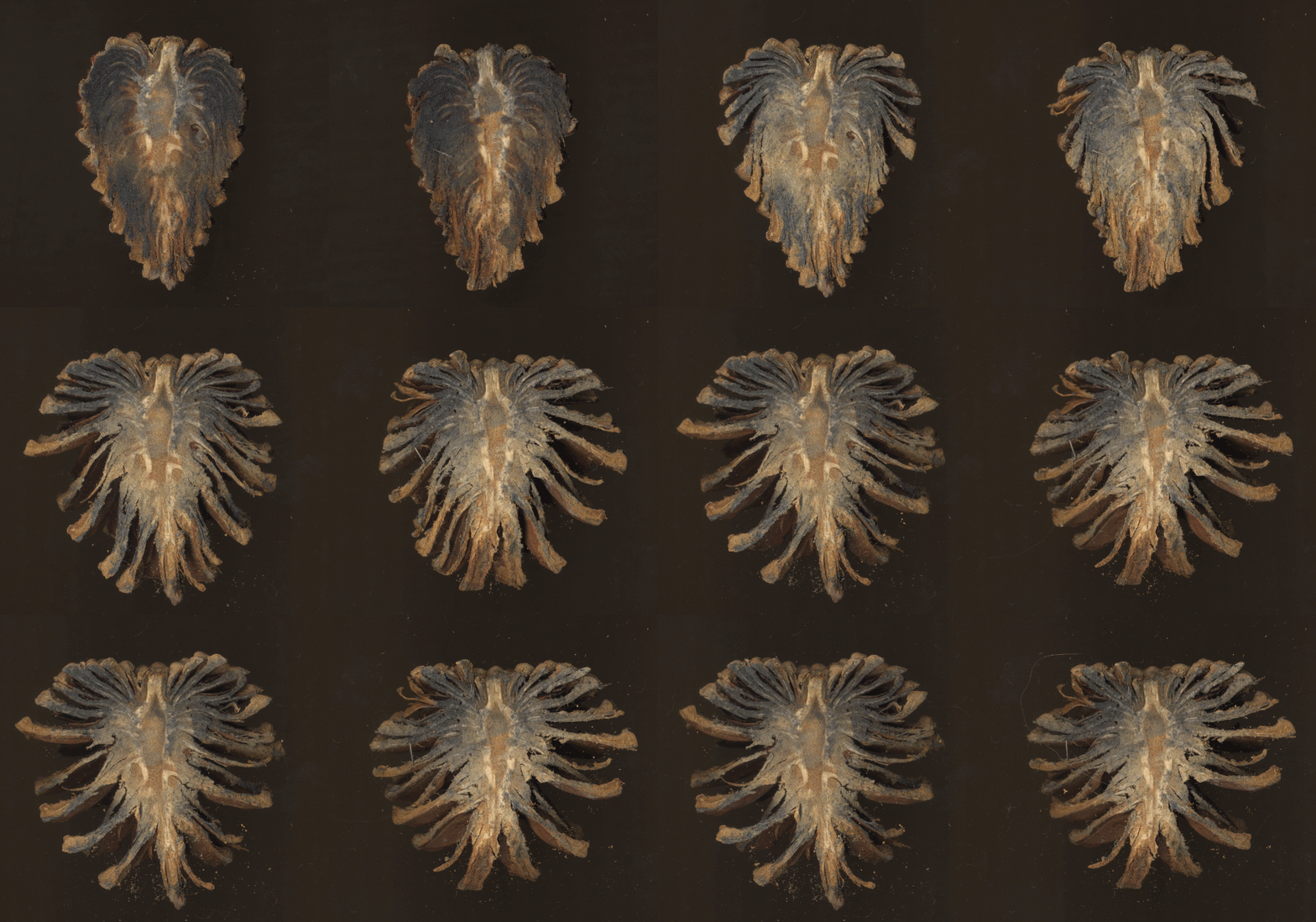
Now that I know for certain these pine-cones can right themselves, I decided to make a proper time-lapse of a cone as it dried to try and determine how they can do this. I soaked one of the dry cones in water overnight to get it to close up again, then I cut it in half length-wise (with a flat plunge-cutting oscillating tool) and placed the two halves on a flatbed scanner. The cut surface of the cone [at left] was slightly charred while cutting, but this shouldn't be a problem for the experiment.

I wrote up a script to control the scanner, automating it to take one image every hour for up to four days. From the resulting images, I constructed the animation shown below. The flat surface of the halved cone kept it from moving around [too much] as it dried.

The images could hypothetically be used to calculate how the center-of-mass changed as the pinecone dried and thus concisely describe why the pinecones rolled onto their ends. Even without any actual calculations, it is apparent from the animation that the center-of-mass is shifting towards the stem-end during the drying process. (Each scale carries its mass stemwards as it dries, thus the cumulative center-of-mass shifts stemwards as the pinecone dries.) At some point, the center-of-mass shifted past the tipping point and the pinecones rolled over on their end.

Time-lapse of drying pinecone in cross-section. Pinecone goes from fully closed to fully open.
100 hour time-lapse of drying pinecone halves.

Something is evident in the animation that I wasn't expecting. Towards the end of the sequence, the animation seems to stall a couple of times as well as move backwards a bit at the very end. We were having a very humid couple of days during the time-lapse and this interfered with the final drying of the pinecone. If I do another time-lapse, I'll have to have it stretch over a longer time-span than the 100 hours I used for this one.

Several pinecones scattered under the tree. Eight are resting upright, four are resting on their sides.
Pinecones, upright and laying down.
I don't expect this will happen with every type of pinecone, but it seems to happen routinely with the pinecones produced by this tree. I took a picture of the ground beneath the tree. Of the twelve pinecones in the frame, eight are more-or-less upright. This is a much higher percentage than I would have expected from simple random falls. I didn't do an exhaustive survey of all the pinecones under this tree, but the photo is basically representative of what I saw. With the previous experiments showing the cones can right themselves during drying... it isn't unreasonable to infer that (across wet and dry spells) the pinecones in this photo have been reorienting themselves to point upwards after their random orientations upon falling from the tree.

What benefit might the tree get in having its pinecones reorient themselves? Maybe the winged seeds are spread better by the wind from upright pinecones. I really don't know. I do know I'm not planning to do the experiments needed to come to a conclusive answer to the question. I'm also pretty sure this behavior isn't seen in the pinecones produced by all types of pine trees, so it is likely a behavior that evolved under selection (even if the behavior is incidental to selection on the pinecone shape for unrelated reasons).

Tuesday, April 26, 2016

Growing Bur Oak Trees (Quercus macrocarpa)

Oak trees (Quercus spp.) have a long history of being used as a food source. Acorns are produced in large amounts by older trees, usually in alternating years. This fruiting strategy, called "masting", helps to prevent the population of seed predators from overwhelming the tree and killing every acorn every year.

1. Bur Oak (Q. macrocarpa)
acorn cap.
I've made an occasional habit of tasting acorns over the years. They routinely have the strongly bitter taste of tannic acid, but occasionally I find one that doesn't taste so bad. When I was in Texas for my oldest brother's funeral (November 2014), I found a nice Bur Oak (Q. macrocarpa) tree on a walk. The tree had a few acorns (in huge caps) on its branches, but the ground beneath was littered with them in various conditions. I broke open one intact looking acorn with my shoe. I noted the nut-meat looked in moist and in good shape, so I picked up one of the pieces and tasted it. The juice tasted distinctly sweet, with no bitter aftertaste.

I was astounded by this and collected a large handful of the best looking acorns I could find. I then continued with my walk. Back at my parents' house, I put the acorns in a resealable plastic bag and put them with my things. When I returned home to Minnesota, I added some moisture to the bag and put it into a basement micro-fridge I've dedicated for botanical specimen storage.

2. Bur Oak acorn; partially
dissected and sprouting.
(USA quarter for scale.)
A year and some four months later (March 2016), I decided to try growing the acorns. Winter here was wrapping up and I was already growing a Chestnut (Castanea spp.) tree in my basement. I took the acorns out of the fridge to examine them. I had previously extracted one nut-meat from its shell and found it had begun to mold. I discarded this one and opened up a few others. Each acorn with an intact shell survived storage without molding.

3. Germinating acorn.
I left the acorns (shelled, partially shelled, and intact) in a dark, but room-temperature spot and waited. By late in March, I noticed a small swelling forming on one acorn (images 2 & 3). At first I wasn't sure if I was actually seeing a change in the acorn, but once I was sure that I was, I removed the remaining membrane layer from around the germinating acorn embryo to get a better view of it.

4. Germinating naked acorns.
I had fully extracted two of the acorn nut-meats during my examination for mold. Once I noted the one acorn germinating, I took a look at these two. Both were obviously germinating too. One (image 4, left) had split in two, revealing the anatomy of the embryonic oak tree and its two cotyledons. To stabilize the baby tree, and partly mimic the acorn shell I had removed, I secured the cotyledons together with some small cable-ties. I secured the other naked acorn in the same way.

5. Stem growth.
Three of the germinating acorns are planted into air-pruning planters (just like the Chestnut trees). The acorns produced a stout taproot which extended to the bottom of the planter well before the stem had grown an inch or unfolded its first leaf. After stalling for a while at less than an inch tall, the stem started elongating rapidly.

6. Air-pruning in process.
The taproots were too thick to pass through the screen material, so the either terminated on impact or grew sideways for a bit before catching on the screen and terminating (or as in image 6, growing through the screen anyway). Many side roots then grew, soon after poking through the bottom of the planter.

As long as the large and tasty nut remains attached to the seedling, it will be a strong incentive to squirrel predation. I suspect I'll have to keep the baby trees in protective custody until at least summer of 2017. One tree will probably go into the back corner of my yard. (There are some very large Buckthorn specimens there to clear out first.) The others will probably go to my wife's family farm, joining a pair of the chestnut trees to form the start of a nut orchard.


7. Bur Oak range, source, and me.
This species of Oak is native to a large swath of the central part of this country (figure 7). The specimens at the extreme southern part of the range tend to produce larger acorns than those at more northern locations. It seems that this gradient is in part due to the history of glaciation on this continent and the improved ability of individuals with smaller acorns to travel north into areas where it was previously extirpated, though the details have not been fully worked out.

If these very southern trees manage to survive the cooler climate here in Minnesota, they should start producing their first acorns in somewhere from 10 to 35 years (depending on who you talk to). Hopefully I'll still be around (at somewhere between 48 and the ripe old age of 73) to collect some acorns and make a few meals of them. For the purposes of the ongoing domestication of the tree as a food source, I hope I'll also be able to convince the young'uns around at that time to plant some acorns from the best of my trees so as to grow their own.


References:

Tuesday, April 12, 2016

Growing Chestnut Trees (Castanea spp.)

A couple of years ago, a member of a forum I frequent offered to send some Chestnut (Castanea spp.) tree seeds to interested parties. He has been breeding Chestnut trees over the last decade and was interested in sharing the results of his work. I expressed interest and soon after a small box arrived, packed with seeds from a few different sources. The box was far larger and held far more seeds than I expected the individual was going to send me.

The seeds were collected from a range of different Chestnut trees:
  • Chinese seedling (C. mollissima)
  • Miller's Hope (C. mollissima)
  • Szego (seedling of Linden; mostly C. mollissima/C. crenata)
  • Gillet (seedling from Colossal; C. sativa/C. crenata)
  • Kaibutsu (seedling from Colossal; C. sativa/C. crenata)
  • Silverleaf (C. sativa/C. crenata)
  • Double Sweet
  • Patterson
Most of them have a mixed ancestry, but all have been selected for high production of large edible nuts. From a long-term view, growing these varieties is entirely about the ongoing domestication of chestnuts as a food source, i.e., improving food security through increasing the diversity of our food plants.

American chestnut range vs. me.
Growing these chestnuts has nothing to do with resurrecting the American chestnut (C. dentata), which is something I consider a very important goal. The American chestnut, in the pre-blight era, dominated the Eastern Woodlands and provided food for a thriving ecosystem (and economy) that has been only a shadow of its former self. Go over to www.acf.org to read more about what they're doing to restore this tree to the dominant role it used to have. Because I live well outside the native range for the American chestnut, I'm not worried about interfering with the their restoration by growing closely related trees that can cross successfully with the American chestnut.

From a short-term view, I'm interested in growing chestnuts simply because I want to grow a new food source. I like having a hand in producing the food I eat and I'm interested in the process of domesticating plants to be better foodstuffs for the future. There really is nothing like planting a tree, that will probably outlive me, for having a future perspective.


When I received the package of chestnut seeds, I had just moved into a new house and didn't have the resources on hand to build the rodent-proof growing area I would need to keep baby Chestnut trees alive. They rely on the nutrients found in the seed for the first year, which is a long time to be exposed to hungry squirrels that like to pull up newly-sprouted nut trees to get at the buried nut. (I learned this when one pulled up a baby Black Walnut tree I was tending, ate the previously-buried nut, then left the uprooted seedling beside its pot.) I had read that Chestnut tree seeds could stay viable for a few years if kept chilled, so I planted a handful of the seeds and kept the others in the fridge. My idea was that by next spring I'd be able to build them some proper protection.

1. Radicle extending.
One of the first batch of seeds germinated and started growing. After it was a few inches tall, the growth point died. A few new branches formed below that point, but their growth points soon died. This pattern repeated a few times before the whole plant died. It had never produced a single leaf, but had branched several times while trying to.

2. Hypocotyl beginning to extend.
I spent some time thinking about what went wrong with that seedling. On the idea that it was getting too much water and developed a fungal infection of some sort, I decided to build a potting system that would allow the seedlings to drain much better. I built a set of primitive air-pruning pots and a raised wire-mesh platform so they could drain. In addition to the better drainage, these pots should help encourage the development of a healthier root system (so the seedling will better survive transplant later in the season).

3. New leaves.
Of this second batch of seeds, only one (a seed from the variety "Kaibutsu") has woken up so far. It is growing happily and is just opening its second set of leaves. The remainder of the seeds seem to have either succumbed to a mold, or are still waiting to wake up. There are reports of chestnut seeds derived from hybrid origin (as most of these are) having reduced germination, but I would need to test a similar batch of seeds as a control. Without that control, I'm left with hoping more decide to germinate, that the elongated winter they experienced didn't kill off the remaining seeds.

4. LED lighting.
When this seedling started waking up, I put it near the front door where I could keep a close watch on it to make sure it didn't dry out. After it grew a couple inches, the drive to find light became the stronger factor guiding its growth and it began tilting towards the nearby window. To help keep the seedling from becoming permanently crooked, I built a rack that holds an LED floodlight directly over it. The base of the structure is a platform extending forward underneath the tray holding the plants, so it has very little risk of falling over. This setup should keep the seedling growing straight until it is time for it to go outside.

5. New lighting and further growth.
After a few more leaves had grown, it became apparent the lighting setup I built was too bright for the seedling. Leaves closer to the light were looking sunburned, while those further away were colored lightly brownish from photo-protective pigments. I think the new fixture produces more light overall, but it is spread over a larger area and so the peak intensity is lower. (This new fixture can also provide light for other plants, like those carrots.)

6. Roots.
The home-made air-pruning pot seems to be doing its job. There are little roots poking out all over the bottom of the container. The roots start out whitish, but then turn a dark brown as the tip dies and dries out. At some point soon, I'll have to transplant the seedling to a larger air-pruning pot. This will allow it to become larger/stronger as well as giving us the time to figure out where it should go into the ground and how to protect it from deer and other hazards. I might be able to make such a planter the same way I made this one, but I suspect I'll have to go with a bit more robust commercial offering.


References:

Tuesday, March 15, 2016

From Weeds to Trees and Back Again (and Again)


In a post a few weeks ago, I discussed the evolution of trees and gave a few examples illustrating how simple it is (evolutionarily) to transition from a tree to a weed or back. "Evolutionary time" is generally interpreted to mean "a very long time" and probably "a long time ago". Most of the interesting evolutionary transitions people think about took place long in the past, so these interpretations aren't entirely without cause.

However, evolution definitely happens over very short time frames, we just have to pay attention for long enough to notice it. The image at right is a composite of a the flowers from a bunch of different individual specimens of the California Wild Radish. This population is derived from hybridization between feral Garden Radish (Raphanus sativus) and wild Jointed Charlock (Raphanus raphanistrum) in the central valley of California.

During the process of forming this hybrid population, the ancestral species were absorbed and eradicated. (Well...  garden radishes still exist just fine, but they're not actively reproducing in the wild of California any more.) The population is full of plants with all sorts of lovely shades of color (including nice combinations with both pink and yellow pigment) because the genetics of the population is still sorting itself out.

One specific plant caught my interest. Its flowers were pretty, but didn't stand out from the many others I'd already seen that day. What did stand out... was that this plant was a woody shrub which has been growing for several years. Both R. sativus and R. raphanistrum (the parent species) are annual weedy plants.

How long did it take for this [small] tree to have evolved from the weedy ancestors? The weedy parents merged together over just an estimated hundred years. So, it took something less than a hundred years for an albeit small tree to have evolved from its herbaceous weedy ancestors. I think that's a pretty quick transition.


Almost every reference I can find talking about the California Wild Radish only talk about herbaceous weedy forms. At best, there is the occasional reference to some plants being short-lived perennials. I haven't found any descriptions of woody perennial California Wild Radish plants growing as shrubs. The next time I visit this part of the country, I hope to spend some time looking for more specimens like this. If I'm lucky, I'll be able to collect some seeds and then grow out such a plant for a more detailed examination in the lab.


References: