// Twitter Cards // Prexisting Head The Biologist Is In

Tuesday, July 12, 2016

Ant Mimicry

Ants are often unpalatable to insect-eating birds due to the formic acid present in their abdomens, so they're often avoided in favor of other prey items. Any potential prey item that happens to look like an ant will have a better chance to live another day than one that doesn't. This selective pressure seems to have led many unrelated arthropods to take on body forms (and behavior) that mimic those of ants.

There are a large number of ant mimic spiders, that often look remarkably like the ant species they're associated with. Because they look like the ants, they are free to go about their business hunting the ants without intervention by birds. The ant mimic mantis probably gains the same freedom to hunt near ant colonies, though I haven't read anything specific about its life-style.

Though I have seen ant mimics in real life (spiders and the occasional beetle), I don't have any of my own photos for illustration. Because they mimic the behavior of ants (in addition to the look), they tend not to stay still for my camera. I've never really gotten a good photo of an ant either, for the same reason.

The photos that follow here were found around the web and I have no legal claim to them, though I feel their educational use here should provide me some protection as fair-use under US copyright law.

Spider that looks very much like a black ant.
Spider
Cricket that looks very much like a black ant.
Macroxiphus sp cricket.
Predatory true-bug that looks very much like a black ant.
Dulichus inflatus (Hemiptera)
Beetle that looks like a red and black ant.
Euderces beetle.
A small mantis that somehow looks like a large black ant.
Asian Ant Mantis (Odontomantis planiceps)
References:

Wednesday, July 6, 2016

"Invasive" Squirrels

Map of the eastern US, with ranges of grey and red squirrels overlaid. Grey squirrels live in the eastern half of the country. Red squirrels life in the north and north-east part of the country. A star marks Minneapolis, MN.
Range of American Red Squirrel (Tamiasciurus hudsonicus).
Range of Eastern Grey Squirrel (Sciurus carolinensis).
There are two native tree squirrel species in Minnesota. The Eastern Grey Squirrel (Sciurus carolnensis) would be familiar to almost anyone living in the eastern half of the USA, while the American Red Squirrel (Tamiasciurus hudsonicus) would be familiar to many people living in the north-east corner of the country (as well as most of Canada).

I happen to live in the native range of both species. I see them routinely in our yard... especially around the bird-feeder. The Greys climb down from above and snack directly from the feeder, while the Reds seem content with grabbing the seed spilled to the ground by avian visitors.

The Reds are about half the size of the Greys, but are much more feisty. We've watched single Reds aggressively attack single Greys, leading to the inevitable retreat of the larger Grey. The reds are generally more feisty, including in the intensity of their scolding calls when we scare them away from the porch.

The Greys make treetop nests out of leaves and branches. The Reds make homes of old woodpecker nests, burrows, or gaps in human establishments. We had to partially deconstruct a rear porch ceiling to discourage investigations by one Red, but most are content to reside in the piles of old wood just inside the edge of our woods.


What got me thinking about squirrels was a discussion with my wife and a third party. The third party referred to the red squirrels as invasive. Both my wife and I responded that they actually were native to the area. Later I realized that the root of the disagreement likely came down to different definitions of the word "invasive". We were interpreting the word in the context of the red squirrels being native. The third party might have been thinking of the word in the context of the red squirrels invading human structures. I don't know that this was their meaning and I don't expect to bring up the subject again with them, but this realization helps reinforce the need to be clear on what are meant even by terms in common use. (I previously posted a more extended conversation about the meanings of "diversity" in biological contexts.)

If you find someone saying something that at first strikes you as absurd, it may be because they're using words differently than you are. Don't simply discount them as being incoherent. Try to determine what they mean, not just what they say. Once you've gotten through the barrier caused by sharing the same language, their experience may help expand yours.


References

Monday, June 27, 2016

Metals in Biology

For any regular readers, I'm sorry to have missed posting last week. I was knocked offline by my computer spraying sparks (from a failed video card). After some troubleshooting, I determined that increasing amounts of sparks would be generated each time I applied supplementary power to the video card. So, now I have a nice and new video card and can once again do computery things.


Even though such things seem to be more in the realm of science-fiction than biology, I really like the idea of metals being used in biological systems. Specifically, metals being used for their structural characteristics, not simply as ions in protein complexes (hemoglobin, chlorophyll, cytochromes, etc.).

If the sauropod dinosaurs had built their bones from steel, they might have been able to grow far larger than they did. If turtles grew iron into their shells, they would be protected from even the most determined of [existing] predators. Organisms with metal threads through their skin might be able to perceive and/or generate radio waves. Essentially anything our technology uses metals for would potentially be within the realm of evolutionary biology (since it all comes down to physics in the end). The world would be a very different place.


It turns out that some organisms actually do grow metal in specialized tissues. Well, not exactly metal, usually, but more like heavily metal-reinforced tissues.
Metal-infused tissues have appeared sporadically in a range of lineages. In every example I've been able to find, the tissues are directly involved in predation or defense. The ever-present biological arms-race between predator and prey has drove the evolution of advanced [metal] weaponry and armor. Maybe one of the lineages will adapt to use metal more generally and evolve into a space-living creature that can migrate to other star systems and thus survive the death of our sun. Maybe I should read less science-fiction before bed-time.


References

Tuesday, June 14, 2016

How to Make a Better Strawberry

Drawing of wild strawberry plant, with smaller drawings illustrating details of flower and other part structure.
Over the last few years I've collected numerous isolates of the Woodland Strawberry (F. vesca) from around Minnesota and Wisconsin. Most of the isolates went into a strawberry tower I had picked up at a garage sale, with each isolate being given a separate pocket of soil. An isolate I found in the far back of our property was planted in a pot all on its own away from the others. I put all the containers near my garden and then proceeded to mostly ignore them for the rest of the year. I wasn't going to baby them along, so only the real survivors would prosper.


It was soon obvious that one of the isolates in the strawberry tower was dramatically better at spreading. It took over the tower and then spread to every nearby bit of exposed soil. This plant originally came from a patch of sandy soil above a large boulder adjacent to a lake in northern Minnesota, fully exposed to the sun. This plant was obviously a determined survivor.

The isolate from our property grew well. It produced large leaves and occasional robust runners which it dropped over the edge of its pot. I didn't think much of it at the time.

At the onset of winter, I continued my strategy of not caring for the plants. The planters containing the strawberries were left out to experience the full brunt of (the admittedly mild) winter. I treated some nice Garden Strawberry (F. x ananassa) plants I had received midsummer much better. Their pots were covered in leaves and then placed up against the basement wall under a porch packed with other items being stored for the winter. I had previously had difficulty overwintering strawberries, so I took efforts to protect them.


Once the earliest hints of spring arrived, the Woodland Strawberry plants started to wake up. The aggressive spreading isolate was found to be just as aggressive about surviving. (The other F. vesca isolates in the tower were not so much.) Every pot that it had spread into last year was soon full of new growth. This plant's thin runners didn't seem to let it spread into the tall grass around the pots last year, however, as there are no lawn strawberries where those pots were kept. Right now the plants are putting out flowers in impressive numbers. I expect any berries will be much larger than the tiny examples the plant produced last year, as the whole of the plant is much larger and happier looking this year.

Out in the yard where I kept the isolate from the back of the property, I found some robust strawberry plants growing. Some of this plant's runners had settled into the tall grass around its pot and found their way to the soil where they were able to survive the winter. The parent plants in the pot itself, however, did not survive.

The Garden Strawberries that I took efforts to protect... completely died out. One bit of vital green did make it to spring, but it soon turned brown and joined its conspecifics in the afterlife. Fortunately, I can easily get more plants from garden centers and other sources.


It would be really nice to have a plant that combined the extreme hardiness of the Woodland Strawberry and the larger berries of the Garden Strawberry, so I started thinking about hybridizing them.

All known strawberries (genus Fragaria) have a basic chromosome number of seven. Wild species range from diploid (2n) to decaploid (10n) with every even number of chromosome sets represented. There are also the occasional naturally formed sterile hybrids with an odd number of chromosome sets.

The two species of strawberry in my collection have a different number of copies of each chromosome.
F. vesca (Woodland Strawberry; 2n)
F. x ananassa (Garden Strawberry; 8n)
If the two species are crossed, sterile pentaploid plants result. To get around this, researchers have used colchicine to double the chromosomes in F. vesca. Crossing a tetraploid F. vesca with an octaploid F. x ananassa should result in a fertile hexaploid plant. The resulting plants ended up being decaploid instead, perhaps by the involvement of unreduced gametes from the octaploid parent with normal diploid gametes from the tetraploid parent (8n + 2n -> 10n). With this model, the hybrid plants would be 20% F. vesca and 80% F. x ananassa. Back-crossing this hybrid to either parent would result in changes in chromosome number with sterility being the result for most cases (x 2n F. vesca -> 6n; x 4n F. vesca -> 7n; F. x ananassa -> 9n), so this plant is essentially a dead-end with respect to further breeding for improvements.


Chromosome doubling in F. vesca can theoretically be done twice to produce octaploid plants (2n -> 4n -> 8n) that could then cross with F. x ananassa to produce an octaploid hybrid.  The hybrid would be 50% F. vesca and 50% F. x ananassa. It would also be able to be back-crossed to either parent without producing progeny with sterility issues due to odd numbers of chromosomes. This would make the hybrid far more useful for further breeding projects, such as combining the extreme hardiness of F. vesca with the tasty and large berries of F. x ananassa.

Earlier I mentioned using colchicine to double the chromosomes of F. vesca. Colchicine is a toxic alkaloid originally processed from Autumn Crocus (Colchicum spp.). The compound interferes with the polymerization of tubulin into microtubules, thus preventing the migration of chromosomes to spindle-pole bodies during cell replication. The effect of this is that newly doubled chromosomes during cell replication aren't split into two new cells, thus a single cell remains with twice as many copies of each chromosome as it started with.

Plants with increased ploidy often have phenotypic changes, such as thicker stems/leaves and larger fruit. Even when the overall plant remains much the same, an increase in ploidy can be observed by noting an increase in the size of pollen grains. If there is no apparent change, even in the pollen, then one would have to count the actual chromosomes to be sure the chromosome doubling protocol has worked.


So, when will I set about doing this? I've got so many projects lined up, that I don't know when or if I will actually do this. I really like the idea, and the protocols aren't all that difficult (or dangerous), but my resources are limited, so we I'll have to stick with, "We shall see." for now.

Anyone else interested in taking a go at it in the meantime? If you do, please let me know of your progress.


References:

Tuesday, June 7, 2016

Pinecone Motility

Recently, I carried a found pine-cone into my work and set it on my desk. After a couple days, I noticed how much it had changed shape after drying. The cone was elongated and tightly closed when fresh. After drying, it was short and had its scales opened in a way that made it readily sit upright on its end.

I decided to do an observational experiment. I went and retrieved two more fresh pine-cones and set them at my desk, where I could watch them dry as I worked. Upon arriving at work the second day, one of the cones was sitting on its end. The second cone was mostly open and was on its side. I assumed that nobody had been messing with my desk and that the first cone had righted itself, but was annoyed I had missed the action. Around 3pm, while I was looking at the computer monitor above the pine cones, the second cone rolled over and righted itself. (Ah hah! I caught you!)

Pine cone cut in half, showing cut face.
Closed pinecone in cross-section.
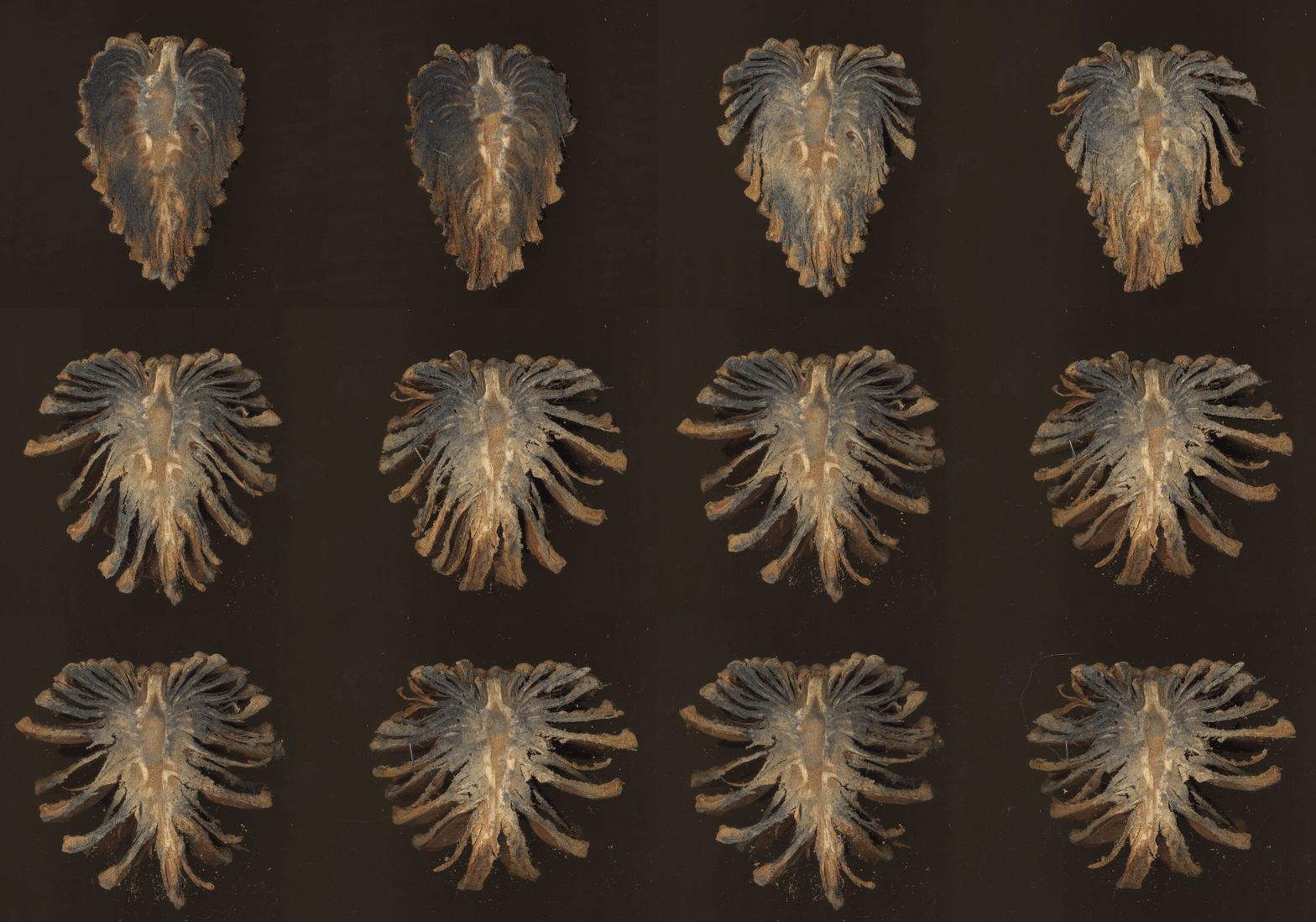
Now that I know for certain these pine-cones can right themselves, I decided to make a proper time-lapse of a cone as it dried to try and determine how they can do this. I soaked one of the dry cones in water overnight to get it to close up again, then I cut it in half length-wise (with a flat plunge-cutting oscillating tool) and placed the two halves on a flatbed scanner. The cut surface of the cone [at left] was slightly charred while cutting, but this shouldn't be a problem for the experiment.

I wrote up a script to control the scanner, automating it to take one image every hour for up to four days. From the resulting images, I constructed the animation shown below. The flat surface of the halved cone kept it from moving around [too much] as it dried.

The images could hypothetically be used to calculate how the center-of-mass changed as the pinecone dried and thus concisely describe why the pinecones rolled onto their ends. Even without any actual calculations, it is apparent from the animation that the center-of-mass is shifting towards the stem-end during the drying process. (Each scale carries its mass stemwards as it dries, thus the cumulative center-of-mass shifts stemwards as the pinecone dries.) At some point, the center-of-mass shifted past the tipping point and the pinecones rolled over on their end.

Time-lapse of drying pinecone in cross-section. Pinecone goes from fully closed to fully open.
100 hour time-lapse of drying pinecone halves.

Something is evident in the animation that I wasn't expecting. Towards the end of the sequence, the animation seems to stall a couple of times as well as move backwards a bit at the very end. We were having a very humid couple of days during the time-lapse and this interfered with the final drying of the pinecone. If I do another time-lapse, I'll have to have it stretch over a longer time-span than the 100 hours I used for this one.

Several pinecones scattered under the tree. Eight are resting upright, four are resting on their sides.
Pinecones, upright and laying down.
I don't expect this will happen with every type of pinecone, but it seems to happen routinely with the pinecones produced by this tree. I took a picture of the ground beneath the tree. Of the twelve pinecones in the frame, eight are more-or-less upright. This is a much higher percentage than I would have expected from simple random falls. I didn't do an exhaustive survey of all the pinecones under this tree, but the photo is basically representative of what I saw. With the previous experiments showing the cones can right themselves during drying... it isn't unreasonable to infer that (across wet and dry spells) the pinecones in this photo have been reorienting themselves to point upwards after their random orientations upon falling from the tree.

What benefit might the tree get in having its pinecones reorient themselves? Maybe the winged seeds are spread better by the wind from upright pinecones. I really don't know. I do know I'm not planning to do the experiments needed to come to a conclusive answer to the question. I'm also pretty sure this behavior isn't seen in the pinecones produced by all types of pine trees, so it is likely a behavior that evolved under selection (even if the behavior is incidental to selection on the pinecone shape for unrelated reasons).

Tuesday, May 31, 2016

Night of the Hopping Amphibians!

I recently went out to my car after dark to retrieve a bag of pine-cones (for a later posting). On my way down the stairs, I heard a "churp" and saw a grey, patterned frog a few steps down. I politely stepped aside, then scooped it up. I set it down in a shallow puddle on one of the steps and continued to my car. When I opened the door, the light cast downwards onto a toad who was hiding flat-like against the gravel. I scooped it up too, then set it on a nearby wall where I would be able to find it in a minute or two. I retrieved the items from my car and quickly returned inside to grab my camera and a light source.

Grey treefrog on purple surface.
Hopper #1
On the way back down the stairs, I picked up the frog again and placed it on a vertical part of the railing. It took a few pictures before I got one I liked. What I thought was a very bright LED flashlight turned out to be just barely bright enough to get decent exposures with the lens I was using.

American toad tucked down into dirt.
Hopper #2
The toad was hunkered down into a shallow spot on the wall. This was perfectly fine for taking its portrait, as it let me brace the camera against the very stable concrete. I picked the toad back up and placed it on the ground near the base of the wall.

Two green-colored treefrogs.
Hopper #3
After finding the two critters, I took a walk around the house to see if I could find any more. I didn't immediately notice any, but I did notice I had left a pepper plant where deer would be able to get to it. I started to move the pepper to a more protected location when a little green frog came popping out.

Single grey spotted treefrog.
Hopper #4
After another quick search, I headed back inside. As I came up the steps, I found the first frog was where I had left it. I also found a smaller grey frog about a foot further up the railing.

We've just had an intensely rainy day and the warm season is far enough along that there are plenty of bugs around. This was apparently the perfect night to go looking for amphibians.


The three frogs likely belong to the same species. They could be either the "Cope's Grey Treefrog" (Hyla chrysoscelis) or the "Grey Treefrog" (H. versiclor). Both species change color from a pale grey, to near black, to bright green depending on their emotional state and the surroundings they're trying to hide in. It can be difficult to be sure which species is in hand. They have slightly different patterns of coloration and different pitches to their calls. Biologically, the biggest difference between them is in how many chromosomes they have. H. chrysoscelis is diploid, while H. versicolor is tetraploid. I suspect the frogs in my yard are H. versicolor, based on the example photos I've found, but I'm really not certain.

The identification of the toad is much simpler because the "American Toad" (Anaxyrus americanus) is a distinct member of the few toad species known in Minnesota.


References:

Tuesday, May 24, 2016

Botanizing in Alaska: Northern Bluebells

Plant with single blue bell-shaped flower. Bumblebee investigates flower.
1. Mertensia paniculata.
Around the house we were staying at in central Alaska, the woods were full of this lovely blue-bell flower (fig 1). The name we knew for the plant was Comfrey (Symphytum officinale).

Three clusters of purple bell-shaped flowers.
2. Symphytum officinale.
At the Fairbanks University botanical garden, we found a plant labeled as Comfrey (fig 2) that looked quite distinct from the plants in the woods. With its larger and more purple flowers, we thought it was strange. We interpreted the differences as being related to the plants being from different varieties. Many domesticated versions of flowers look distinct from their wild relatives, after all.

Looking through a list of Alaska native flowers, I found our blue flowered friend. It is named Mertensia paniculata ("Northern Bluebells" or "Chiming Bells") and grows as a woodland wildflower throughout central Alaska. The flowers and overall growth form of the two species are remarkably similar for not being in the same genus. The two genera are in in the same family, the Boraginaceae, so the similarities make some sense in the end.

I did succeed in collecting seeds for M. paniculata, so I might be able to get further pictures of the species later this season.


References: